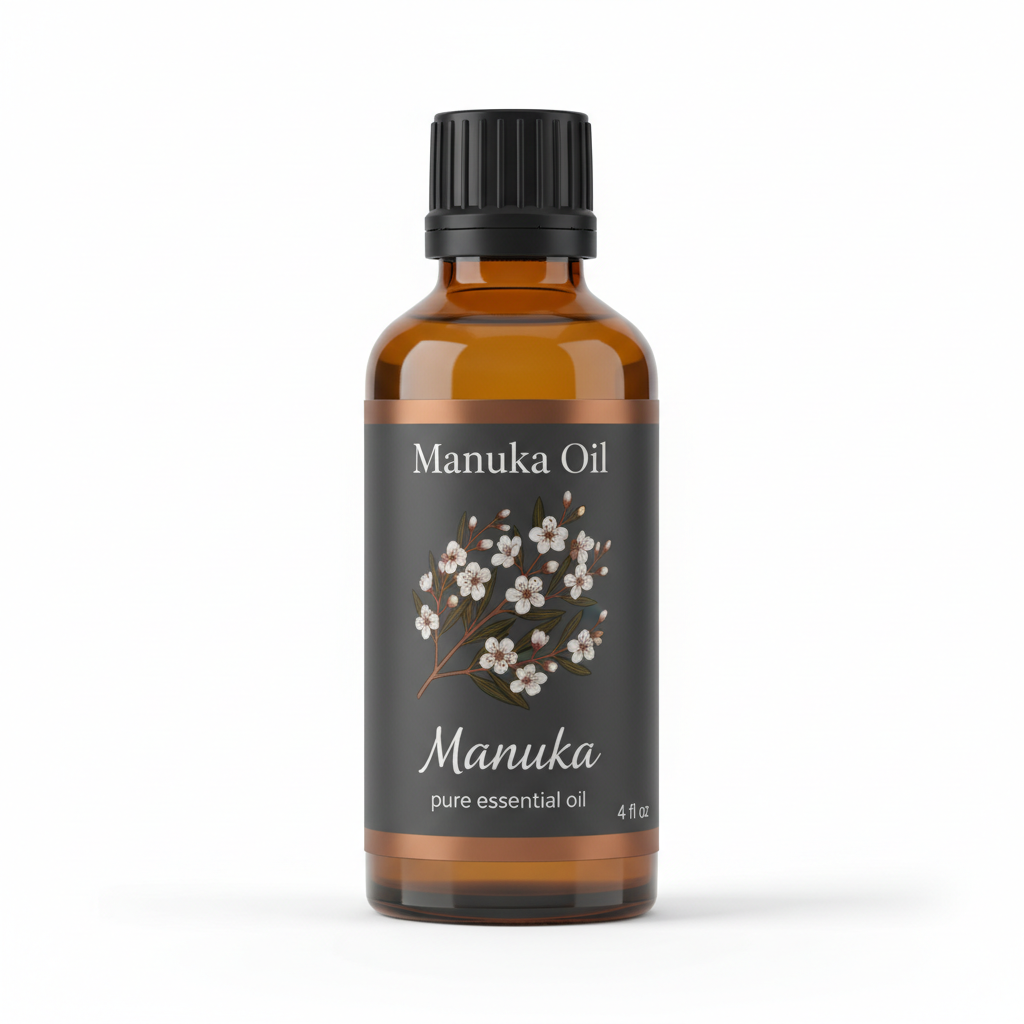
Manuka essential oil is distilled from the leafy branches of Leptospermum scoparium, a hardy relative of tea tree. Its aroma is earthy, honeyed, and warm, with a slightly spicy edge that feels deeper and sweeter than tea tree and settles into a blend like a wood oil.
Honeyed, earthy warmth sets it apart, with a spicy depth that runs sweeter and richer than tea tree.
Published COA is posted on the site for review, and the oil is sold as botanical grade.
Nine sizes run from 0.5 oz to 400 lbs, covering sampling bottles through production quantities.
We happily take bulk orders for manuka oil. Every size, from 0.5 oz to 400 lbs, comes from the same standard, so formulators, makers, and resellers are welcome to scale up from a sample bottle without changing anything.
Manuka essential oil is concentrated botanical material. For skin use, dilute to 0.5% to 2% in a carrier oil and patch test on a small area first. Keep away from eyes, children, and pets. Not for internal use. Store tightly capped in a cool, dark place away from heat and sunlight.
Frequently Asked Questions
How pure is your manuka essential oil? ▾
Manuka Essential Oil is sold as botanical grade. Our published Certificate of Analysis is available on the site for review. If you need specifics about composition or how a batch is handled, contact us and we will gladly answer before you order.
Is manuka oil the same as tea tree oil? ▾
They are relatives, but not the same oil. Manuka comes from Leptospermum scoparium, while tea tree is a different plant with a sharper, cleaner scent. Manuka smells earthy, honeyed, and warm, with a deeper sweetness, and it comes from the shrub behind the well-known honey.
What does manuka oil smell like and what does it blend with? ▾
Expect an earthy, honeyed, warm aroma with a slightly spicy edge. It anchors a blend the way a wood oil might and pairs nicely with lavender, citrus, geranium, and other bush and forest notes. A drop or two goes a long way in a diffuser.
How do I dilute manuka oil for skin use? ▾
For skin use, dilute to between 0.5% and 2% in a carrier oil such as jojoba or sweet almond. That is roughly 3 to 12 drops per ounce of carrier. Patch test first, keep it away from eyes, and start at the low end for facial blends.
What sizes do you offer, and do you sell wholesale? ▾
We offer nine sizes, from 0.5 oz to 400 lbs: 0.5 oz, 1 oz, 2 oz, 4 oz, 8 oz, 16 oz, 5 lbs, 25 lbs, and 400 lbs. Wholesale and bulk orders are welcome from formulators, makers, and resellers. Contact us if you have an unusual quantity in mind.
How does the price per ounce change across sizes? ▾
Per-ounce cost falls steadily as the size goes up. The largest size works out to less than half the per-ounce price of the smallest bottle, so stepping up makes sense once you know you will use it. Exact prices for each size are shown on the product page.
Do bulk orders come with lab documentation? ▾
Yes. Every size is covered by our published Certificate of Analysis, from the 0.5 oz bottle to the 400 lbs size. If you need anything further for your records or a formulation file, contact us before ordering and we will see what we can provide.
Which size should I choose? ▾
Start with 0.5 oz or 1 oz to learn the scent and test a blend. The 2 oz, 4 oz, and 8 oz sizes suit regular diffusing or small batches. Makers pouring candles or soap often reach for 16 oz and 5 lbs, while 25 lbs and 400 lbs fit production and resale.
How fast do orders ship? ▾
Orders ship within 1 to 2 business days. Bulk sizes of 5 lbs and up may need extra handling, so allow a little more time for them. Checkout is through our Shopify store, and you can contact us beforehand if you have questions about a large order.
How does manuka behave in a blend? ▾
Think of manuka as a grounding base, much like a wood oil. Its earthy, honeyed warmth sits beneath brighter notes such as citrus and lavender, and it rounds out geranium and forest-style blends. Use it sparingly so it supports the scent rather than leading it.