Manuka Oil for Cold Sores? What Lab Studies Show
Search for manuka oil and cold sores and you will find an exciting-sounding lab result. It is a genuine result, and it is worth understanding properly, because the distance between a cell-culture dish and a lip is much longer than it looks.
Manuka Essential Oil
Our own Manuka Essential Oil, in sizes from 0.5 oz to bulk.
From $18.99
Shop Now →What the dish studies found
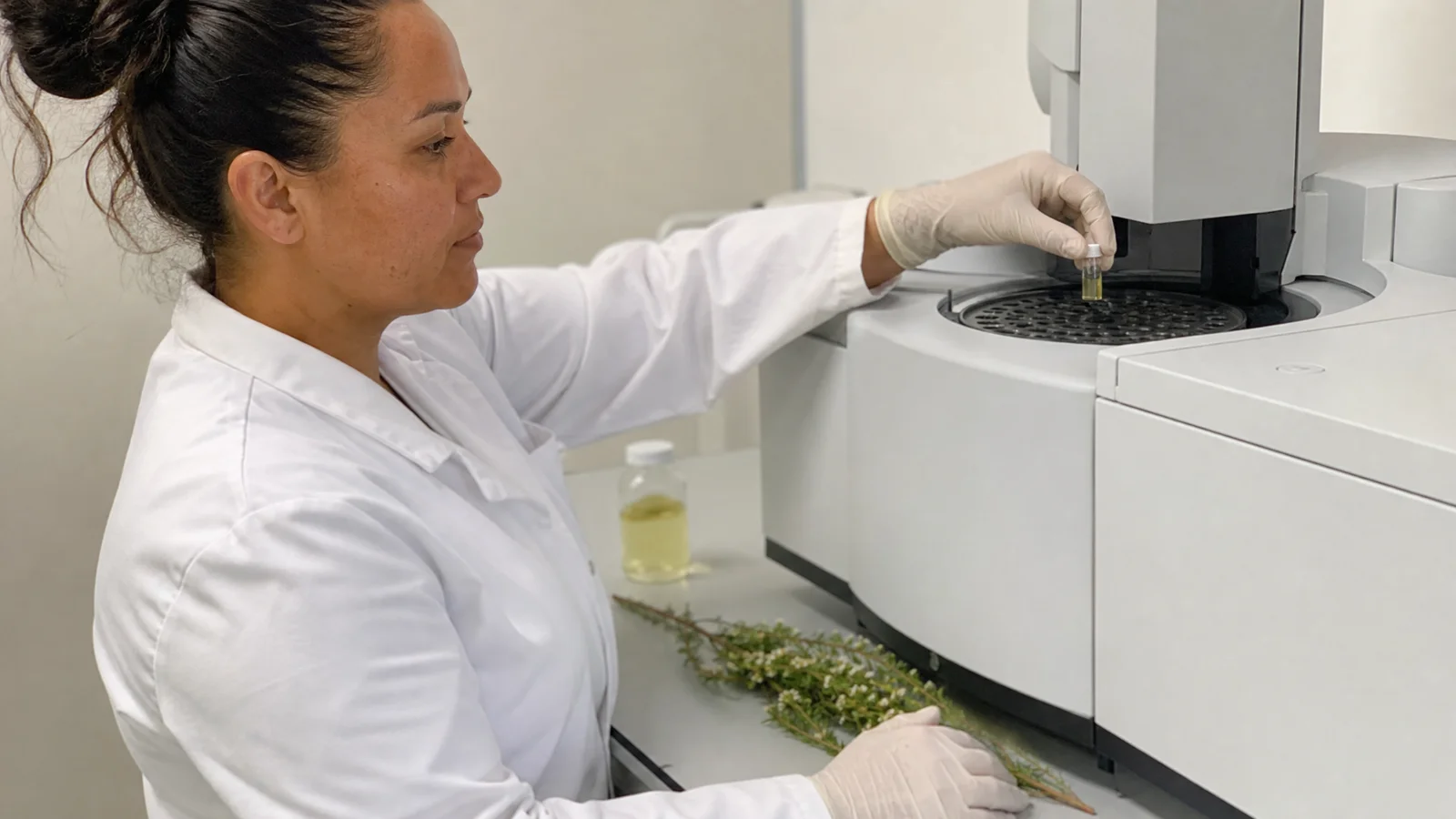
A review of the manuka oil literature summarises the main experiment. A beta-triketone-rich manuka oil was tested on monkey kidney cells infected with herpes simplex virus. The concentration that halved infection was about 0.0001% for type 1, the virus behind most cold sores, and about 0.00006% for type 2. Pre-treating the virus with the oil worked better than pre-treating the cells, which suggests the oil acts on virus particles floating free in the liquid before they reach a cell (Mathew and colleagues, 2020). The same research group found a very similar pattern with tea tree oil, which reduced plaque formation by more than 90% at concentrations the cells could tolerate, again mainly before or during attachment to cells (Schnitzler and colleagues, 2001).
It makes a good story, but think about what a cold sore actually is. By the time you can see one, the virus is already inside skin cells and multiplying there, not drifting in a liquid waiting to be met by an oil. A dish test captures the first scenario, and a lip is the second.
A little arithmetic on scale
The 0.0001% in that experiment is one part in a million. We recommend diluting manuka oil to 0.5% to 2% in a carrier for general skin use, which is 5,000 to 20,000 times stronger. That does not mean more is better; the dish and the lip are different systems, and a bigger number is not a bigger benefit. It simply shows that the laboratory figure is a measurement, not a dose, and that we are not aware of any human trial that links the two for manuka oil.
Why we would keep oil away from the mouth anyway
Lips get licked, so anything put on them is partly swallowed, and we do not recommend manuka oil for internal use. The skin there is thin, and an irritant or allergic reaction on a cold sore would be hard to tell apart from the sore itself. There is also a hygiene point from the American Academy of Dermatology: the cold sore virus spreads easily, often contaminating products used on or near the lips, which is why dermatologists suggest dabbing medication on with a clean cotton-tipped swab and throwing away lip products used during an outbreak. A dropper bottle that touches a sore and goes back into the cupboard is exactly the kind of thing that advice is guarding against.
How to read a laboratory headline
When you meet a striking result online, a few quick questions will keep you grounded. Was it done in a dish or in people? What concentration was used, and how does it compare with anything you would ever put on your skin? Which exact oil, and which exact virus or microbe? And has anyone repeated it with real patients? Most exciting headlines about essential oils stop at the first question. It does not make the work worthless; it simply tells you where on the road from the laboratory to the bathroom shelf the finding currently stands.
Who to ask, and when
The NHS says cold sores usually clear on their own within about 10 days, and that a pharmacist can recommend antiviral creams. These work best when you use them at the first tingle, because they do not always work once blisters have appeared (NHS). It suggests seeing a GP if a sore is showing no sign of improving after 10 days, is very large or painful, or if you have a weakened immune system. Kissing a baby when you have a cold sore can pass on a serious infection, so keep a distance from newborns.
The AAD adds its own list for seeing a dermatologist or doctor: a cold sore near an eye, several at once or a lot of pain, one lasting longer than two weeks, six or more outbreaks in a year (some people then take a low daily dose of antiviral medication), eczema, or a weakened immune system (AAD). If any of those sounds like you, a professional is the right next call.
Where manuka oil belongs
We sell manuka essential oil as an aroma and cosmetic ingredient, neat, so the dilution is yours to do. It has a warm, earthy, honeyed scent that settles into blends beautifully, and that is where we like to talk about it. Cold sores are a medical matter, and we leave them to pharmacists and doctors. If you want to read about the laboratory side of manuka oil more broadly, our antibacterial research and research overview pages walk through what has been studied and how to read the numbers, and safety basics covers patch testing for ordinary skin use.
If you want to enjoy manuka oil, enjoy it for what it is. Open the bottle and give it a slow sniff from a few inches away: earthy, honeyed, warm, a little spicy. Put a drop or two into a diffuser blend or a diluted body oil for healthy skin, and keep it well away from your lips.
A cold sore is a short-lived visitor for most people. Antiviral cream at the first tingle, a clean swab and a bit of patience will do more than any experiment in a dish.
Manuka Essential Oil
Manuka Essential Oil from our own shop, in sizes from 0.5 oz to bulk.
From $18.99
Shop Now →Sources & Further Reading
- NHS, "Cold sores - NHS"
- American Academy of Dermatology, "Cold sores: Diagnosis and treatment"
- Mathew C and colleagues, 2020, "Mānuka Oil - A Review of Antimicrobial and Other Medicinal Properties"
- Schnitzler P, Schön K, Reichling J, 2001, "Antiviral activity of Australian tea tree oil and eucalyptus oil against herpes simplex virus in cell culture"