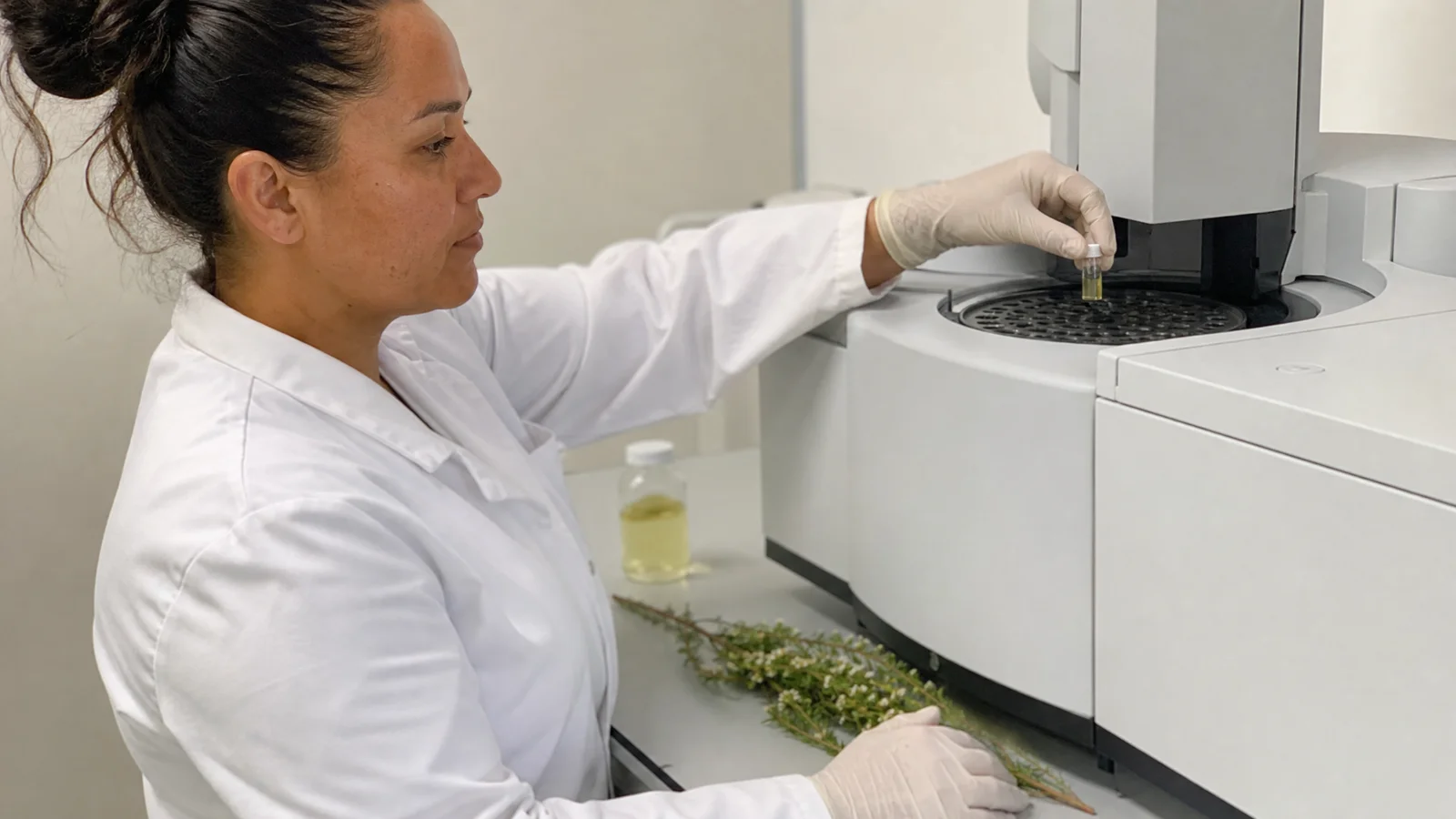
Manuka Oil Triketones: How to Read the Number on a Label
Look at enough manuka oil labels and one phrase keeps returning: triketone content. Sometimes it is a bold percentage, sometimes a grade. It is a real and interesting feature of the oil, but the number means more once you know what was counted, in what, and how.
Manuka Essential Oil
Our own Manuka Essential Oil, in sizes from 0.5 oz to bulk.
From $18.99
Shop Now →A family of compounds, not one
Beta-triketones are a group of related molecules. A 2024 study of manuka leaf and branch material names five: leptospermone and its isomer isoleptospermone (which the authors' methods could not separate), flavesone, grandiflorone and myrigalone A. Leptospermone, isoleptospermone and flavesone are the volatile ones typical of manuka essential oils. Grandiflorone is described as difficult to extract by steam distillation because of its low volatility, so much of the non-volatile group stays in the leaves and branches left behind.
So only part of the family travels into a steam-distilled oil. When a label says "high triketone" without saying which compounds were counted, it has told you less than it seems to.
The figures in the literature
Published numbers range from under 1% to well over 20%, and they describe different things.
| Study | What was measured | What it reported |
|---|---|---|
| Christoph et al., 1999 | 16 commercial New Zealand oils | Triketones averaged 22.1%; four oils averaged 14% |
| Douglas et al., 2004 | Oil from 261 individual plants at 87 sites | All 36 East Cape plants above 20% total triketones; Marlborough Sounds up to 20% |
| Mathew et al., 2020 | Review of commercial samples | Leptospermone 0.8 to 19.4%; flavesone 0.7 to 5.8% |
| Kaur et al., 2023 | Three producer-supplied oils | Labelled 5%, 25% and 40%; measurement method not described |
It helps to read the rows as separate measurements, not one scale. One counts total triketones in oil from single plants, another counts individual compounds in commercial oils, and the last is a supplier's label. The 2020 review adds that East Cape material tends to carry higher triketone levels, and that Australian-grown plants are described as having almost no triketones. Our East Cape article picks up the question of region.
What a helpful label looks like
If you are comparing bottles, here is what we would hope to see beside a triketone number. A botanical name. A lot number you can match to a document. A plain statement of what was counted and how. None of it needs to be long. A line or two, in writing, from the seller is worth more than a bold percentage on the front of a box.

It also helps to decide, before you shop, whether you need the number at all. Plenty of people want manuka for its warm, honeyed scent in a diffuser blend or a candle, and for that purpose the aroma in the bottle is the thing to judge. A triketone figure becomes important when your project names it, and then you want it from the seller, in writing, for the lot you will receive.
How we would read a triketone claim
Three questions decide whether one label compares with another: which compounds were added up, what method measured them, and what was measured, a single lot, a blend or a plant. The same review says there is a clear need for standardization of manuka oil. Until there is one, a triketone grade is best read as a seller's statement, and our suggestion is to ask for the report behind it and read what it says about the method.
The Certificate of Analysis we publish for one batch lists relative density 0.896, refractive index 1.489 and optical rotation of -3.84 degrees, and no triketone figure, so we do not make a triketone claim for our oil. If a triketone or GC-MS report matters to you, ask us in writing through the contact page before ordering and get any answer in writing. Porter and Wilkins found that density tracked the triketone and sesquiterpene content in their commercial oils, which makes density an interesting clue, though a single density figure cannot be placed on their scale because their abstract gives no ranges. Our COA walkthrough explains each line.
A surprise from the garden
Part of the reason triketones are so well studied is farming. A 2022 paper on the herbicide chemistry explains that commercial triketone herbicides were originally discovered by modifying leptospermone, the natural triketone found at the highest concentration in manuka oil, and that they work by blocking an enzyme plants need. A 2011 study then tried manuka oil itself on weed seedlings: it controlled large crabgrass before emergence at 3 litres per hectare, and the oil and leptospermone had half-lives in soil of 18 and 15 days.
That is a fascinating bit of plant chemistry, and it is about plant enzymes and weeds. We draw no conclusion from it about skin, scent or anything else. If you are curious about what the laboratory work on microbes does and does not show, we explain how to read it in our guide to MIC numbers, and our research overview lists what exists.
That is part of why we like manuka: a plant with enough hidden detail to read about for an evening, and an oil you can then simply enjoy for its scent.
Manuka Essential Oil
Manuka Essential Oil from our own shop, in sizes from 0.5 oz to bulk.
From $18.99
Shop Now →Sources & Further Reading
- Xu et al., TLC-Bioautography-Guided Isolation and Assessment of Antibacterial Compounds from Manuka (Leptospermum scoparium) Leaf and Branch Extracts (Molecules, 2024)
- Christoph et al., The composition of commercial manuka oils from New Zealand (J Essent Oil Res, 1999)
- Douglas et al., Essential oils from New Zealand manuka: triketone and other chemotypes of Leptospermum scoparium (Phytochemistry, 2004)
- Mathew et al., Mānuka Oil-A Review of Antimicrobial and Other Medicinal Properties (Pharmaceuticals, 2020)
- Kaur et al., Mānuka Oil vs. Rosemary Oil: Antimicrobial Efficacies in Wagyu and Commercial Beef against Selected Pathogenic Microbes (Foods, 2023)
- Porter and Wilkins, Chemical, physical and antimicrobial properties of essential oils of Leptospermum scoparium and Kunzea ericoides (Phytochemistry, 1999)
- Ooka et al., Synthesis and Activity of 2-Acyl-cyclohexane-1,3-dione Congeners Derived from Peperomia Natural Products against the Plant p-Hydroxyphenylpyruvate Dioxygenase Herbicidal Molecular Target Site (Plants, 2022)
- Dayan et al., Manuka Oil, A Natural Herbicide with Preemergence Activity (Weed Science, 2011)