Manuka Oil MIC Numbers: How to Read the Studies
One drop of manuka oil weighs roughly 45 mg on the density of our published batch (0.05 ml at 0.896 g/ml). Pedonese and colleagues at the University of Pisa reported that manuka oil stopped the growth of Staphylococcus aureus food isolates at 0.233 mg/ml. Work that through and a single drop spread through about 190 ml of liquid, a bit under a cup, would match it. It sounds tiny, and it is a good example of why a laboratory number needs reading carefully before it means anything.
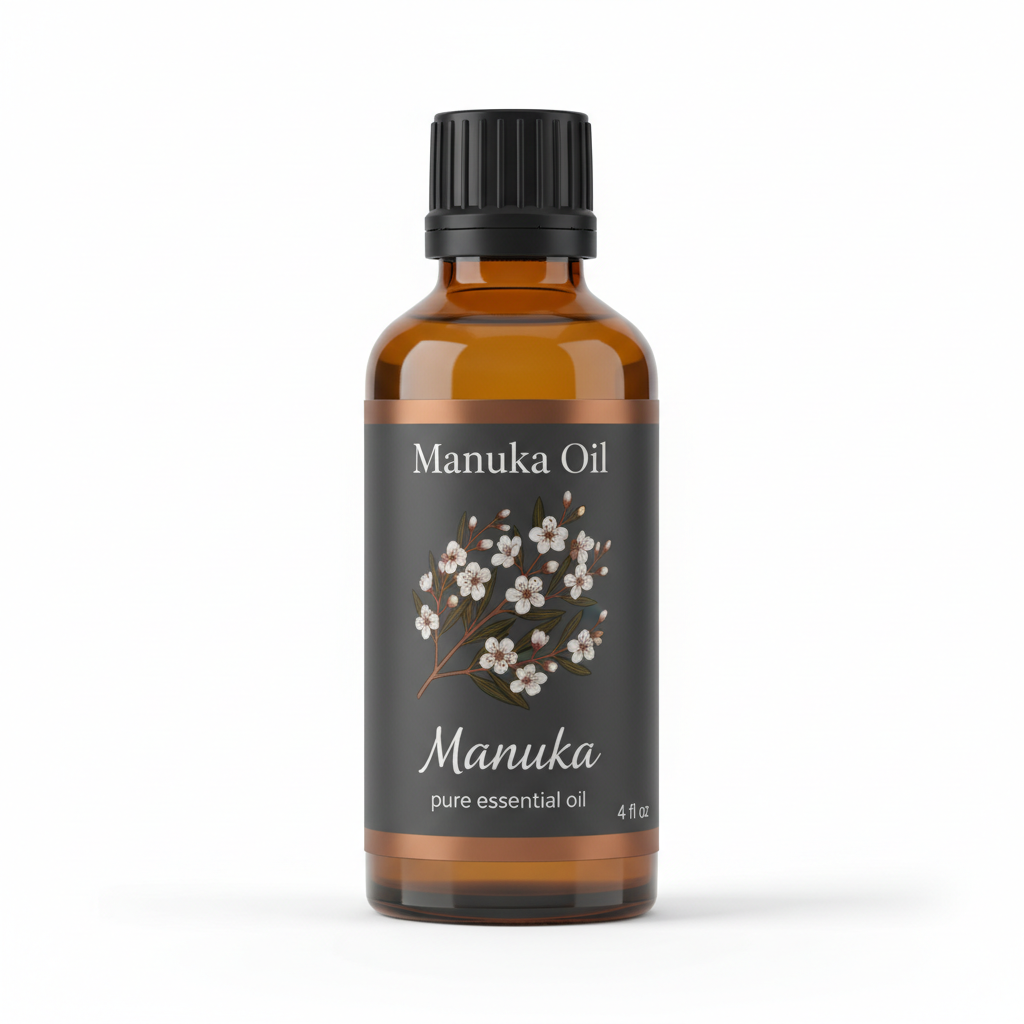
Manuka Essential Oil
Our own Manuka Essential Oil, in sizes from 0.5 oz to bulk.
From $18.99
Shop Now →What an MIC is
MIC stands for minimum inhibitory concentration: the lowest concentration in a dilution series at which a chosen strain showed no visible growth under stated conditions. It belongs to the oil, the strain, the growth medium and the method together. A few questions help you read any MIC.
- Which oil? Chemotype and triketone content change results, and many papers do not say which they used.
- Which microbes? A reference strain or fourteen wild isolates.
- Which method? Agar dilution, broth microdilution and microtiter plates give different numbers.
- Which units? Percent by volume, mg/ml and micrograms per ml differ by factors of thousands.
- What was not tested? Usually skin, and any person.
Three studies, one unit
To compare them, here are the figures in mg/ml. Where a paper gave percent by volume, we converted with the 0.896 density of our batch, so 1% v/v is 8.96 mg/ml. That is an assumption, because those studies used oils with their own densities.
| Study | Oil and microbes | As reported | In mg/ml |
|---|---|---|---|
| Song et al., 2013 | 39 MRSP and 11 MSSP isolates from dogs; agar dilution | 2^-9 to 2^-6 % v/v for MRSP | about 0.0175 to 0.14 |
| Pedonese et al., 2022 | 7 S. aureus and 7 L. monocytogenes food isolates | 0.233 and 0.466 mg/ml | 0.233 and 0.466 |
| Harkenthal et al., 1999 | Gram-positive bacteria; broth microdilution | 0.12% v/v | about 1.08 |
The lowest and highest figures differ by a factor of about 60, for the same kind of oil against the same group of bacteria. That spread is the honest message of the literature: there is no single MIC for "manuka oil", because strains, media and oils all differ. The same 1999 study found tea tree oil at 0.25% against many bacteria, and noted Pseudomonas aeruginosa resisted every oil tested even at 4%, so results also vary a great deal from one microbe to the next. A 2023 paper on producer-supplied oils labelled 5%, 25% and 40% triketones does not describe how those percentages were measured, which is another reason to look at methods before comparing numbers. We look at that side in our triketones article.
A quick way to skim a paper
If you enjoy reading studies, here is a gentle order to do it in. Read the abstract, then jump to the methods and look for the oil, the microbe and the units before you look at a single result. Then see what the authors say they did not test. Reading in that order protects you from the pleasure of a big, tidy number.
Stopping growth is not the same as clearing it
Pedonese's data show the steps nicely. For S. aureus the MIC was 0.233 mg/ml and the minimum bactericidal concentration, which kills rather than only halts, was 0.466 mg/ml, double. Bacteria living in biofilms needed far more: the minimum biofilm inhibitory concentration was 7.461 to 14.922 mg/ml. In other words, the headline number describes the easiest version of the question.
It helps to remember that a dish is a cleaner, simpler place than anything you will ever pour a bottle into. That is its strength for researchers, who can change one thing at a time. It is also why a single figure should be treated as a clue, with plenty of blanks around it.
From a dish to a bottle
It is tempting to compare 0.233 mg/ml with a skin blend. Our dilution guidance is 0.5% to 2% in a carrier, around 3 to 12 drops per ounce. At 0.5% that is roughly 5 mg of oil per gram of carrier. Setting those numbers side by side yields something that looks impressive and means nothing. In a dish, the oil is dispersed in a watery medium and held against the microbes for hours. In a jojoba or almond blend the oil is dissolved in another oil, and on skin it is exposed briefly, then wiped, washed or absorbed. How much reaches anything is unknown, and no study here measured it.
We therefore make no antibacterial claim for our oil and recommend no use against any infection. We sell a cosmetic essential oil for external use, and for a skin concern a dermatologist or doctor is the right person. The studies are interesting chemistry and microbiology; they are not instructions.
Why we bother with all this
We like these papers, and we think readers deserve to see them without the hype attached. A number on a page is a pleasure for the curious. A bottle in your cupboard is a scent and a cosmetic ingredient. Keeping the two apart is the whole point of reading carefully.
If you enjoy reading the original papers, you are now equipped to ask the five questions. Our research overview lists the kinds of studies that exist, our tea tree comparison sets manuka beside its better-known cousin, and manuka versus oregano shows how MIC tables look side by side.
Manuka Essential Oil
Manuka Essential Oil from our own shop, in sizes from 0.5 oz to bulk.
From $18.99
Shop Now →Sources & Further Reading
- Pedonese et al., Antimicrobial and anti-biofilm activity of manuka essential oil against Listeria monocytogenes and Staphylococcus aureus of food origin (Ital J Food Saf, 2022)
- Song et al., In vitro efficacy of the essential oil from Leptospermum scoparium (manuka) on antimicrobial susceptibility and biofilm formation in Staphylococcus pseudintermedius isolates from dogs (Vet Dermatol, 2013)
- Harkenthal et al., Comparative study on the in vitro antibacterial activity of Australian tea tree oil, cajuput oil, niaouli oil, manuka oil, kanuka oil, and eucalyptus oil (Pharmazie, 1999)
- Kaur et al., Mānuka Oil vs. Rosemary Oil: Antimicrobial Efficacies in Wagyu and Commercial Beef against Selected Pathogenic Microbes (Foods, 2023)