What Does Manuka Oil Smell Like? A Honeyed, Low Note
Manuka oil is a slow-burn scent: warm, honeyed and a little earthy rather than sharp and bright. We describe our oil as earthy, honeyed and warm, with a slightly spicy edge, deeper and sweeter than tea tree, and the kind of oil that settles into a blend the way a wood oil does.
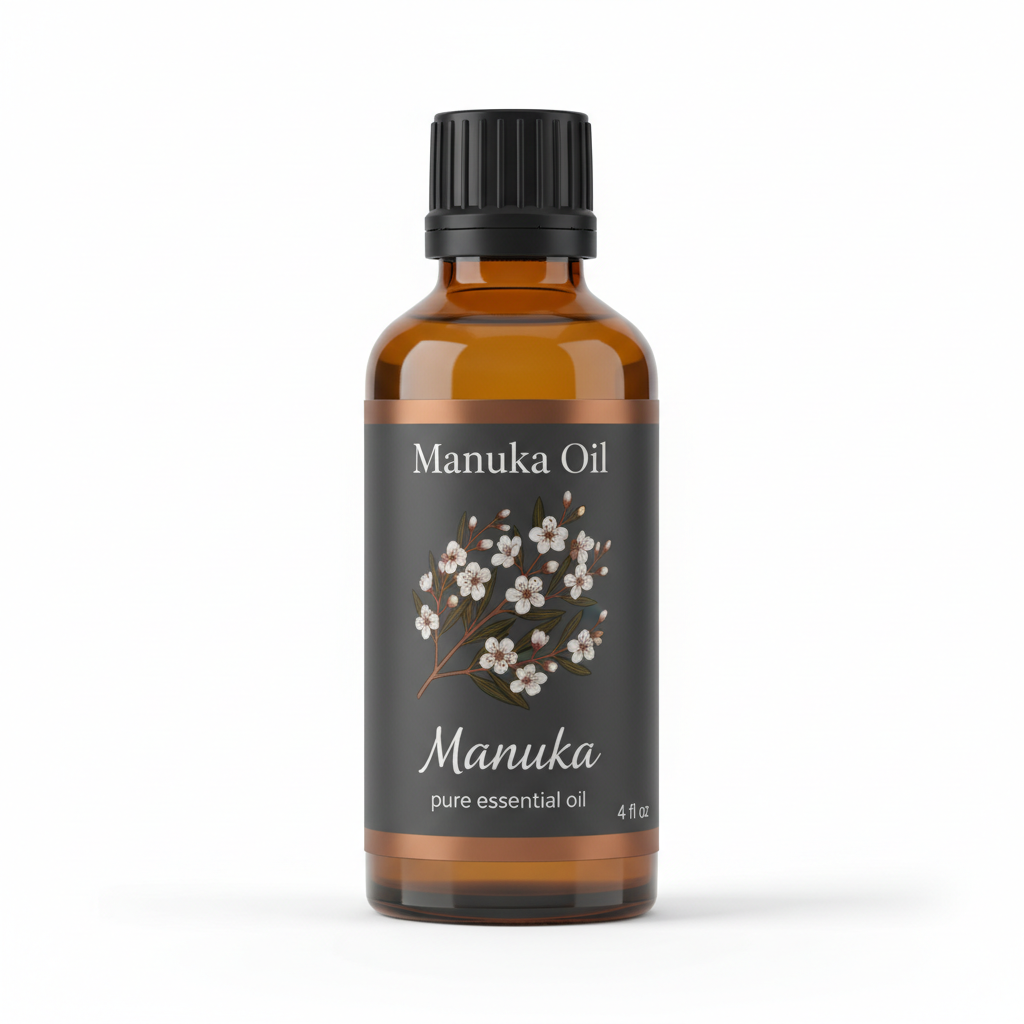
Manuka Essential Oil
Our own Manuka Essential Oil, in sizes from 0.5 oz to bulk.
From $18.99
Shop Now →Two descriptions, one honey thread
The Certificate of Analysis we publish for one batch records the smell as "Sweet, Honey, Herbal." Put that next to our own description and honey is the shared word, while earthy and spicy sit on one side and sweet and herbal on the other. That is not a contradiction so much as a reminder that scent words are personal. Two people smelling the same bottle will reach for different adjectives, and the best way to know manuka is to smell it yourself. If you are curious about the certificate itself, our line-by-line walkthrough covers every row.
Why manuka reads deeper than most
Chemistry offers a satisfying clue. A survey of 16 commercial New Zealand manuka oils found that heavy sesquiterpene hydrocarbons made up 60 to 70% of each oil, with trans-calamenene the most abundant at a mean of 12.5%. Light monoterpenes, the molecules that give tea tree and many citrus and pine oils their bright, quick-lifting top notes, were a small share, from 2.2% to 14.1% with a mean of 4.5%. Reasoning from that, an oil built mostly from large, slow-evaporating molecules should smell low and lingering rather than sparkling, which fits what people describe. We offer that as a reasoned connection, not something the paper measured, because the survey analysed composition rather than aroma.
The same survey found four oils that looked different, with lower triketones and alpha-pinene at 8 to 11%. Manuka is also a plant that varies from place to place: a study of 261 plants from 87 New Zealand sites found a triketone-rich type on the East Cape and ten other chemical types elsewhere, including one rich in geranyl acetate that the authors flagged for its notable aroma compounds. In other words, "manuka" is a family of oils, and a different bottle can smell a little different. We keep that in mind whenever we describe ours.
Numbers on a certificate are not a smell
People sometimes treat the physical figures on a certificate as a stand-in for scent. The batch on our certificate lists a relative density of 0.896, a refractive index of 1.489 and an optical rotation of -3.84 degrees. In commercial New Zealand oils, one study reported that density and refractive index track the sesquiterpene and triketone content, so those figures say something broad about the type of oil. They are not an aroma profile, and they cannot tell you how the oil will feel in your living room.
A sniff test in three steps
- Open the bottle and smell it from about a hand's width away, with one slow breath.
- Put the bottle down and walk away for a minute, then come back, because noses tire quickly.
- Write down the first three words that come to mind. You will probably be surprised how different they are from someone else's.
How to get to know it
This is our practical suggestion, reasoned from the above. Start with a brief sniff from a short distance, since undiluted oil does not belong on skin. Then smell it again once it is diluted in a carrier oil, because a heavy oil at 1% reads differently from the bottle neck, and that is closer to how you will actually wear or diffuse it. Come back after an hour to notice how it settles. And try it next to a partner: lavender, bergamot, sweet orange, geranium and cedarwood are the oils we suggest pairing with it, and our pairing guide goes through them. A citrus partner lifts it; a woody partner deepens it.
Oils change as they age, and light, air and warmth are the usual culprits. The best-documented example is tea tree oil, which developed marked oxidation within days on a window sill, so applying that to manuka is inference, though a sensible one. We recommend a tightly capped bottle in a cool, dark place; our storage post has the details.
Try thinking of it in terms of places. A warm kitchen with something sweet cooling on the counter, a wooden cabin, a dry meadow in late summer. Those are our images, not a measurement, and your own picture will do just as well. A scent you can place is a scent you will want to use.
Is it for you?
If you love bright, fresh, citrus-style scents on their own, manuka is likely to feel heavier than you expect, and it works better as a base in a blend. If you enjoy warm, resinous, woody and honeyed notes, it may become a favourite. A fun side-by-side is our tea tree comparison, and the kanuka article covers the other New Zealand oil with a similar name.
Using the scent well
Because manuka lingers, it suits small, quiet spaces: a study, a hallway, a bedroom drawer. Start with less than you think you need and let the room carry it for an hour before you decide. You can always add a drop; you cannot take one back out of the air.
For skin use we recommend 0.5% to 2% in a carrier oil with a patch test first, and that is separate from how pleasant the scent is: a lovely smell is not a sign that a dilution is right. We make no health claim for our oil, and when it comes to aroma, your own nose has the final say.
Manuka Essential Oil
Manuka Essential Oil from our own shop, in sizes from 0.5 oz to bulk.
From $18.99
Shop Now →Sources & Further Reading
- The composition of commercial manuka oils from New Zealand (Journal of Essential Oil Research, 1999)
- Essential oils from New Zealand manuka: triketone and other chemotypes of Leptospermum scoparium (Phytochemistry, 2004)
- Chemical, physical and antimicrobial properties of essential oils of Leptospermum scoparium and Kunzea ericoides (Phytochemistry, 1999)
- Degradation products of monoterpenes are the sensitizing agents in tea tree oil (American Journal of Contact Dermatitis, 1999)