Manuka or Tea Tree Oil for Nails: What Studies Cover
If you have typed "manuka versus tea tree for nail fungus" into a search box, you were probably hoping for a verdict. The honest picture is more interesting than a winner, and it starts with the nail, not the oil. Here is what has actually been studied for each oil, in plain terms, and why we sell manuka as an aroma and cosmetic ingredient and make no claim about nails.
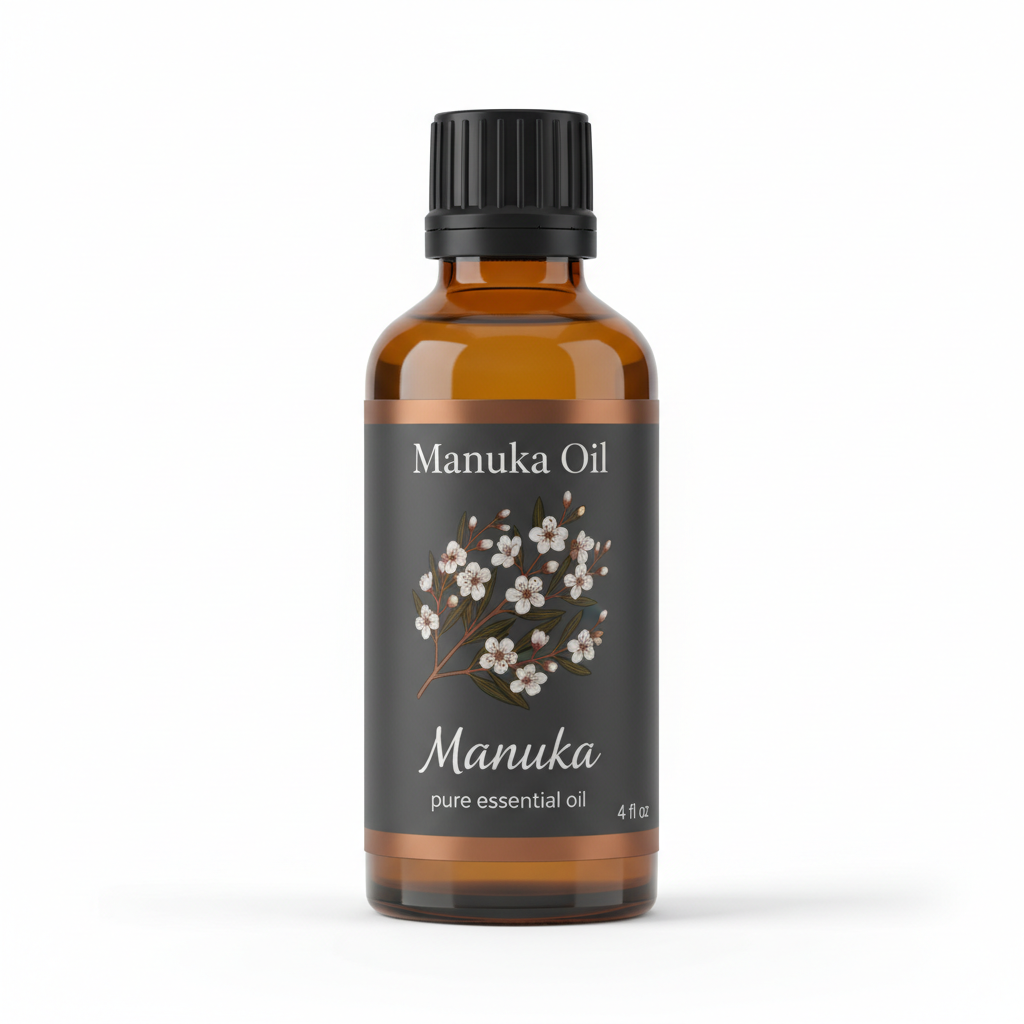
Manuka Essential Oil
Our own Manuka Essential Oil, in sizes from 0.5 oz to bulk.
From $18.99
Shop Now →A thick yellow nail is a question, not an answer
The NHS describes a fungal nail infection as a nail that is brittle, discoloured or thicker than usual, often turning white or yellow, and it points people to a pharmacist for a bothersome or painful nail and to a GP if they have diabetes, a weakened immune system, spread to other nails or a severe infection (NHS, Fungal nail infection). Its antifungal brush-on medicines are used for 6 to 12 months, and may not suit people who are under 18, pregnant or breastfeeding. A nail can look like that for other reasons, so the first step is finding out what is going on, before choosing any product. In the US, a podiatrist or dermatologist is the usual route, and a pharmacy carries the over-the-counter options.
There is a second reason we keep nails out of our product claims. FDA says whether a product is a cosmetic or a drug is determined by its intended use, which can be shown by labels, advertising and websites (FDA, Is It a Cosmetic, a Drug, or Both? (Or Is It Soap?)). A nail-infection claim would make our oil a drug, so we leave it out and simply report the research.
Tea tree: two small human trials
Tea tree oil is a different plant (Melaleuca alternifolia), and it is the oil that has human nail studies. The first compared 100% tea tree oil with 1% clotrimazole solution, an antifungal, in 117 people whose toenail infection had been confirmed by culture. Both were applied twice daily for six months, in a double-blind trial. At six months the laboratory culture was cleared in 18% of the tea tree group and 11% of the clotrimazole group, and partial or full improvement in how the nails looked was about 60% in each (Buck et al., Comparison of two topical preparations for the treatment of onychomycosis: Melaleuca alternifolia (tea tree) oil and clotrimazole). One honest way to read that is that the two preparations did about equally well, and neither result was dramatic: more than four in five people were still culture-positive at six months.
The second trial used a cream with 2% butenafine, an antifungal drug, plus 5% tea tree oil, against a placebo cream in 60 outpatients over 16 weeks. About 80% of the active group were cured and none of the placebo group (Syed et al., Treatment of toenail onychomycosis with 2% butenafine and 5% Melaleuca alternifolia (tea tree) oil in cream). Because butenafine is itself an antifungal, that trial cannot tell us how much the tea tree oil contributed.
Manuka: laboratory work
For manuka the picture is thinner. Two comparisons put manuka and tea tree side by side in the lab. In one, tea tree oil had the best overall antimicrobial effect across sixteen microorganisms, while manuka oil gave the best results against Gram-positive bacteria and dermatophytes, which the authors linked to its beta-triketone content (Christoph et al., A comparative study of the in vitro antimicrobial activity of tea tree oils s.l. with special reference to the activity of beta-triketones). In the other, manuka showed a stronger antifungal effect than kanuka but was not as potent as tea tree, and manuka samples varied more from one to another than tea tree samples did (Lis-Balchin et al., Pharmacological and antimicrobial studies on different tea-tree oils (Melaleuca alternifolia, Leptospermum scoparium or Manuka and Kunzea ericoides or Kanuka), originating in Australia and New Zealand).
These two papers are in vitro, so they describe organisms in dishes, and they stress different strengths. We have not found a human trial of manuka oil on fungal nails, which is the evidence a real head-to-head would need. So this is a comparison the literature cannot yet settle.
How we would read all of this
If we were standing in the aisle with a bottle in each hand, here is how we would think it through. Neither oil answers the question the nail is asking. The tea tree trials were small, used the oil at full strength or alongside a drug, and still left most people with some infection after months. The manuka papers describe dishes. Put together, that is a lot of interesting reading and very little you could act on.
So the practical choice is not which oil but who looks at the nail first. After that, if you love one of these oils for its scent, choosing between them is a question for your nose. Smell both, and pick the one you would be happy to live with.
What this means for how we describe our oil
The Certificate of Analysis we publish for one batch lists a relative density of 0.896, a refractive index of 1.489 and an optical rotation of -3.84 degrees, with no triketone figure, so a result tied to triketone content would not describe ours in any case. The tea tree trial used the oil at full strength twice a day for six months. Our guidance for manuka on skin is quite different: dilute to 0.5% to 2% in a carrier oil, patch test first, not for internal use. A regimen at full strength sits well outside that, so even a positive manuka result at that strength would not be a reason to use our oil that way. Our undiluted-use article explains why.
If you love manuka for its scent and want to use it in your own skin-care blends, soaps or sprays, that is where it shines. For wider reading, see our articles on feet and nails, toenails and manuka versus tea tree.
For a nail you are worried about, a professional look comes first, and the oil question can wait.
Manuka Essential Oil
Manuka Essential Oil from our own shop, in sizes from 0.5 oz to bulk.
From $18.99
Shop Now →Sources & Further Reading
- NHS, Fungal nail infection
- FDA, Is It a Cosmetic, a Drug, or Both? (Or Is It Soap?)
- Buck DS, Nidorf DM, Addino JG, 1994. Comparison of two topical preparations for the treatment of onychomycosis: Melaleuca alternifolia (tea tree) oil and clotrimazole. Journal of Family Practice
- Syed TA et al., 1999. Treatment of toenail onychomycosis with 2% butenafine and 5% Melaleuca alternifolia (tea tree) oil in cream. Tropical Medicine and International Health
- Christoph F, Kaulfers PM, Stahl-Biskup E, 2000. A comparative study of the in vitro antimicrobial activity of tea tree oils s.l. with special reference to the activity of beta-triketones. Planta Medica
- Lis-Balchin M, Hart SL, Deans SG, 2000. Pharmacological and antimicrobial studies on different tea-tree oils (Melaleuca alternifolia, Leptospermum scoparium or Manuka and Kunzea ericoides or Kanuka), originating in Australia and New Zealand. Phytotherapy Research