East Cape Manuka Oil: Does Origin Change the Oil?
Few essential oils can claim what manuka can: a chemical map of the country it comes from. Researchers collected oil from hundreds of individual shrubs across New Zealand and found that the plant does not make one oil but several, and that where a shrub grows says a lot about which one it makes. That is the real story behind the phrase "East Cape" on a bottle, and it is worth knowing what it does and does not promise.
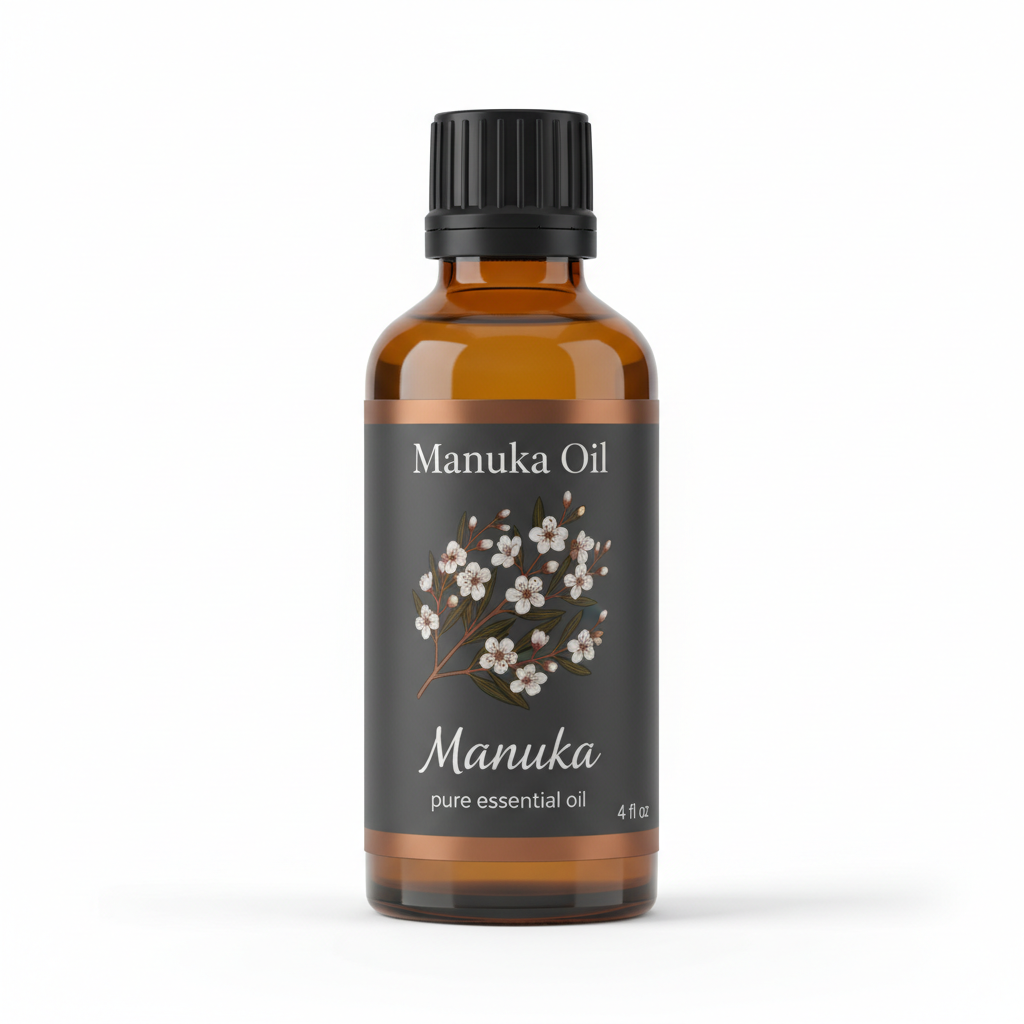
Manuka Essential Oil
Our own Manuka Essential Oil, in sizes from 0.5 oz to bulk.
From $18.99
Shop Now →The survey that drew the map
The study everyone cites analysed oils from 261 plants at 87 sites. On the East Cape, all 36 plants sampled gave oils with high triketone content (above 20% in total) and little change from season to season. Triketones are the heavy, characteristic compounds of manuka oil, and this was the one region where they were reliably abundant. Plants in the Marlborough Sounds area reached up to 20%, and the rest of the country sorted into ten further chemotypes, a word for plants of one species that make distinctly different oils. One type was rich in alpha-pinene, others in different sesquiterpenes, one in geranyl acetate, one in methyl cinnamate and one in linalool. The authors noted that some of these carried aroma compounds at fairly high levels, with the geranyl acetate type the most notable (Douglas et al., Essential oils from New Zealand manuka: triketone and other chemotypes of Leptospermum scoparium).
So "East Cape" is a genuine, measured category, and it is only one of eleven described types. "New Zealand manuka" with no further detail leaves a lot open. A later review of the field makes the same point from the other side: it reports Northland samples richer in pinene and Australian-grown material with higher monoterpenes and almost no triketones, and it calls for a formal standard, which does not yet exist for manuka oil in the way it does for tea tree (Mathew et al., Mānuka Oil-A Review of Antimicrobial and Other Medicinal Properties).
From shrubs to a bottle
A survey describes single plants. A bottle holds a distillate of whatever was cut, perhaps from many plants. When researchers analysed 16 commercial New Zealand manuka oils, they found a consistent backbone, with sesquiterpene hydrocarbons making up roughly 60 to 70% of each oil and triketones averaging 22.1%. Four of the sixteen sat apart, with lower triketones (mean 14%) and a noticeable share of alpha-pinene, 8 to 11% (Christoph et al., The composition of commercial manuka oils from New Zealand). The abstract does not say where those samples were harvested, so it cannot rank regions. What it shows is that two oils both honestly sold as New Zealand manuka can differ in character, and that a region name is a clue about the plants, not a measurement of the oil.
Does it matter for what you want?
It depends on the job. If you are choosing an oil for scent, soap or a blend, the aroma differences that the survey flagged belonged to the minor chemotypes, like the geranyl acetate type, rather than to the East Cape triketone type, and we have not found a study that compares the smell of East Cape oil with other manuka oils side by side. Our shop describes our oil as earthy, honeyed and warm with a slightly spicy edge, and the Certificate of Analysis we publish for one batch records the smell as "Sweet, Honey, Herbal." The practical advice is the old one: smell a sample before you commit to volume. Our scent profile article helps with the vocabulary, and the sample bottles on our wholesale page exist for exactly this.
If you are reading research on manuka oil, triketone content is the variable that scientists track, since many of the lab studies are organised around it. Those studies are done in dishes and say nothing about any particular bottle, which we discuss in our research map.
If you are the sort of person who likes to know a plant before you buy its oil, here is how we would approach it as a reader: go into the research for the story, and go to a sample bottle for the decision. The map is fascinating, but your nose will settle what you actually want to put in a blend or a diffuser. Smell it on its own first, then next to the oils you plan to pair it with, and give it a few minutes, because a heavier, lower note keeps changing in the air.
Good questions for any seller who leads with a region
- Is the region a statement about where the plants grew, and is there a document behind it?
- Has this lot been measured, and is the triketone total given as a number, with the method and the laboratory named?
- Is a figure on the page a measurement of the lot or a range quoted from the literature?
- Is the species Leptospermum scoparium? Kanuka is a different tree with a different oil, which we cover in our manuka versus kanuka article.
A region with a matching measurement is real information. A region on its own is a story about the plants. Our label-reading article shows what each common phrase would need behind it.
Where our oil stands
The certificate we publish is for one batch and lists appearance, smell, a relative density of 0.896, a refractive index of 1.489 and an optical rotation of -3.84 degrees. It has no GC-MS, triketone or origin line, so we make no claim about the region our oil comes from. If your project depends on a triketone figure or a named origin, ask us in writing through the contact page before you order and get the answer in writing, then compare it with the ranges above.
The idea to carry away is simple: region tells you which kind of plant was probably cut, and a measurement tells you what is in the oil.
Manuka Essential Oil
Manuka Essential Oil from our own shop, in sizes from 0.5 oz to bulk.
From $18.99
Shop Now →Sources & Further Reading
- Douglas MH et al., 2004. Essential oils from New Zealand manuka: triketone and other chemotypes of Leptospermum scoparium. Phytochemistry
- Mathew C et al., 2020. Mānuka Oil-A Review of Antimicrobial and Other Medicinal Properties. Pharmaceuticals
- Christoph F, Kubeczka KH, Stahl-Biskup E, 1999. The composition of commercial manuka oils from New Zealand. Journal of Essential Oil Research