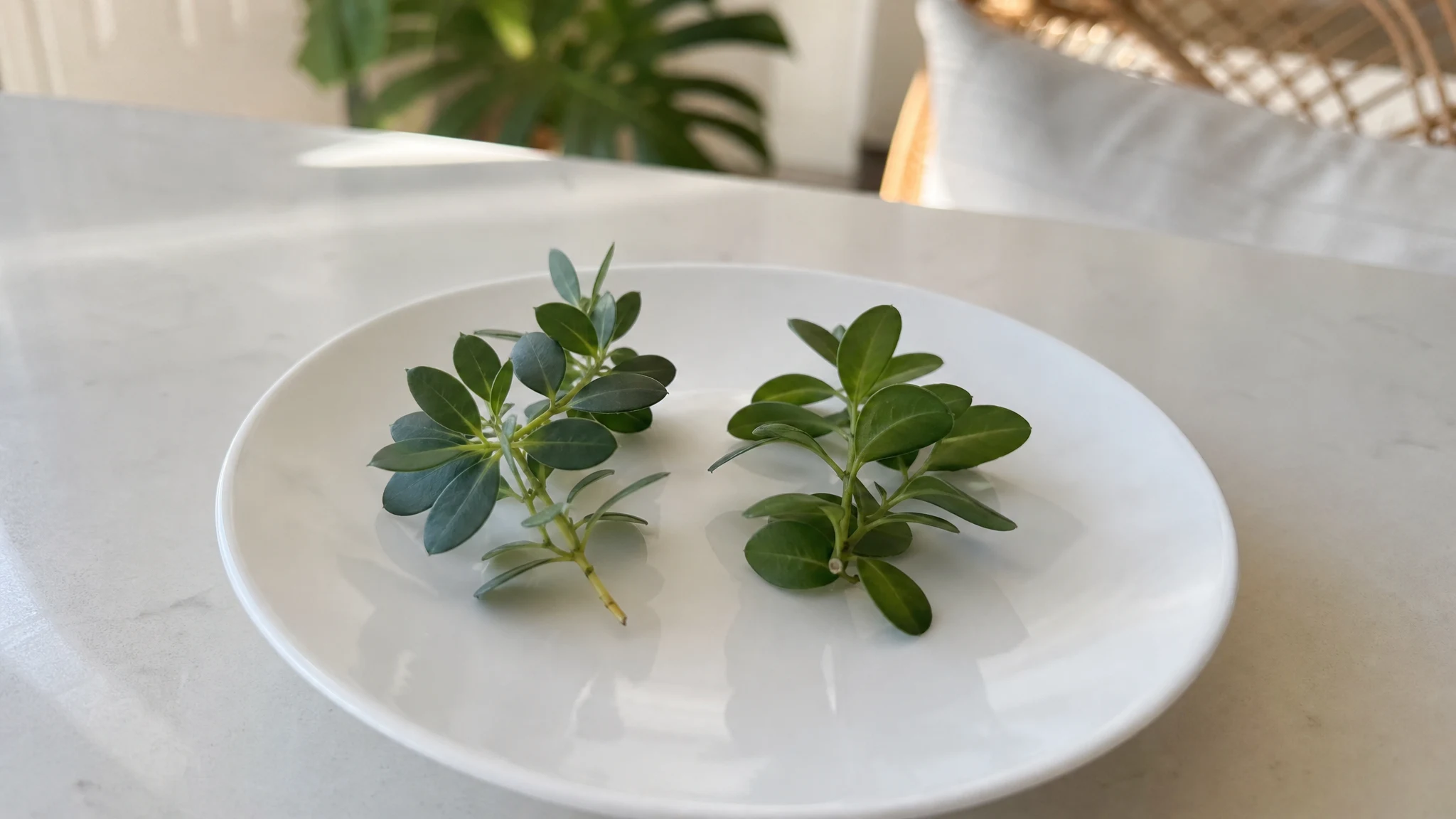
Manuka vs Kanuka Oil: How the Two Differ
In New Zealand, manuka and kanuka grow side by side, look alike to the casual eye, and have names that sound like a pair. In the bottle they are anything but. Manuka oil is heavy, honeyed and built mostly on sesquiterpenes; kanuka oil is built mainly on alpha-pinene, the crisp, piney compound you know from conifers. Same landscape, very different oils.
Manuka Essential Oil
Our own Manuka Essential Oil, in sizes from 0.5 oz to bulk.
From $18.99
Shop Now →Two analyses, two profiles
When researchers analysed commercial New Zealand oils from both plants, the contrast was sharp. In manuka oil, monoterpenes were present only at low levels, sesquiterpene hydrocarbons made up 60% or more, and oxygenated sesquiterpenes plus triketones made up a further share. Kanuka oil was characterised by alpha-pinene above 50%, with small amounts of viridiflorol and viridiflorene. The authors also noticed that density and refractive index in both oils tracked the total sesquiterpene level, so even a simple physical measurement carries a hint about composition (Porter and Wilkins, Chemical, physical and antimicrobial properties of essential oils of Leptospermum scoparium and Kunzea ericoides). A newer study of 99 kanuka oil samples from five land blocks and two seasons, covering 84 compounds, again found alpha-pinene the most abundant (Haira et al., Antimicrobial-guided metabolomic analysis of essential oil derived from the Aotearoa New Zealand endemic plant Kunzea robusta (Kānuka)).
That is a wide gap, and it matches what you would expect from the nose. Pinene-rich oils smell fresh and resinous. Manuka, with its heavier fraction, is warmer, deeper and slower to fade, which is why we describe ours as a heavier, lower note.
Manuka has more than one face too
Before anyone declares manuka and kanuka opposites, one wrinkle is worth knowing. A survey of oils from 261 manuka plants at 87 sites found a triketone-rich type on the East Cape and ten further chemotypes, and one of those was rich in alpha-pinene, the very compound that dominates kanuka (Douglas et al., Essential oils from New Zealand manuka: triketone and other chemotypes of Leptospermum scoparium). A bottle can therefore be correctly labelled manuka and still sit nearer the kanuka end of the aroma range. Two of our articles pick this up from other angles: East Cape versus other origins and the beta-triketones.
Why the names keep shifting
Plant names add a layer. The New Zealand Plant Conservation Network notes that a modern taxonomic assessment of Leptospermum scoparium is urgently needed, and that most Australian forms do not match the range seen in New Zealand (New Zealand Plant Conservation Network, Leptospermum scoparium var. scoparium). Kanuka has been reshuffled more recently. Kunzea robusta was first described in 2014 and is now the most widespread and common New Zealand Kunzea (New Zealand Plant Conservation Network, Kunzea robusta). The older name Kunzea ericoides now applies to a narrower, South Island plant, and most plants sold under that name are in fact K. robusta (New Zealand Plant Conservation Network, Kunzea ericoides).
Reasoning from that, a study of "kanuka oil" published before 2014 may have used either species or a mixture, and abstracts rarely say which. It is sensible to treat the older kanuka literature as describing a trade name rather than a precise botanical identification.
Smelling the difference
If you ever get both bottles in front of you, smell them one after the other with a pause between, and a breath of something neutral, like your own sleeve, in between. A piney, resinous oil tends to announce itself straight away. Manuka is slower: look for the honeyed warmth first, then the earthy, slightly spicy edge underneath.
Notice how each one feels a minute later. A bright, fresh scent often seems to lift away, while a heavier one tends to hang around and settle. That staying power is why we think of manuka as a foundation in a blend rather than the opening note.
Choosing between them
We sell manuka only, so we cannot point you to a kanuka bottle of our own. Here is how we would think about it.
- Choose by the aroma you want. Warm, honeyed and woody points to manuka; green, resinous and fresh points to kanuka. A sample of each beats any description, and our scent profile covers manuka's side.
- Check the botanical name. We sell Leptospermum scoparium. If a label says only "manuka" or "kanuka," ask for the Latin name.
- Read the document, not just the density. The Certificate of Analysis we publish for one batch lists a relative density of 0.896 and a refractive index of 1.489, but no composition data, so by itself it does not tell a reader which chemotype they are holding. Our COA walk-through goes through it. If you need composition, ask us in writing through the contact page before ordering.
The two oils share a landscape, a family and a place in New Zealand's story, and they are worth knowing apart. Our manuka and tea tree comparison tells the story of the other oil people confuse it with.
If you are only starting to explore New Zealand plant oils, smell a sample of each when you can, jot down a few words, and let your nose, not the names, do the choosing.
Manuka Essential Oil
Manuka Essential Oil from our own shop, in sizes from 0.5 oz to bulk.
From $18.99
Shop Now →Sources & Further Reading
- Porter NG, Wilkins AL, 1999. Chemical, physical and antimicrobial properties of essential oils of Leptospermum scoparium and Kunzea ericoides. Phytochemistry
- Haira TH et al., 2025. Antimicrobial-guided metabolomic analysis of essential oil derived from the Aotearoa New Zealand endemic plant Kunzea robusta (Kānuka). Fitoterapia
- Douglas MH et al., 2004. Essential oils from New Zealand manuka: triketone and other chemotypes of Leptospermum scoparium. Phytochemistry
- New Zealand Plant Conservation Network, Leptospermum scoparium var. scoparium
- New Zealand Plant Conservation Network, Kunzea robusta
- New Zealand Plant Conservation Network, Kunzea ericoides