Manuka vs Oregano Oil: Which Suits Which Job?
Ask people which essential oil is "strongest" and oregano is a favourite answer. Its reputation was earned in laboratory dishes, and it is one reason "manuka or oregano?" turns up as a question. Our view is that potency in a dish is the wrong yardstick for choosing an oil to put on skin, and that the two oils are better understood as very different characters than as rivals.
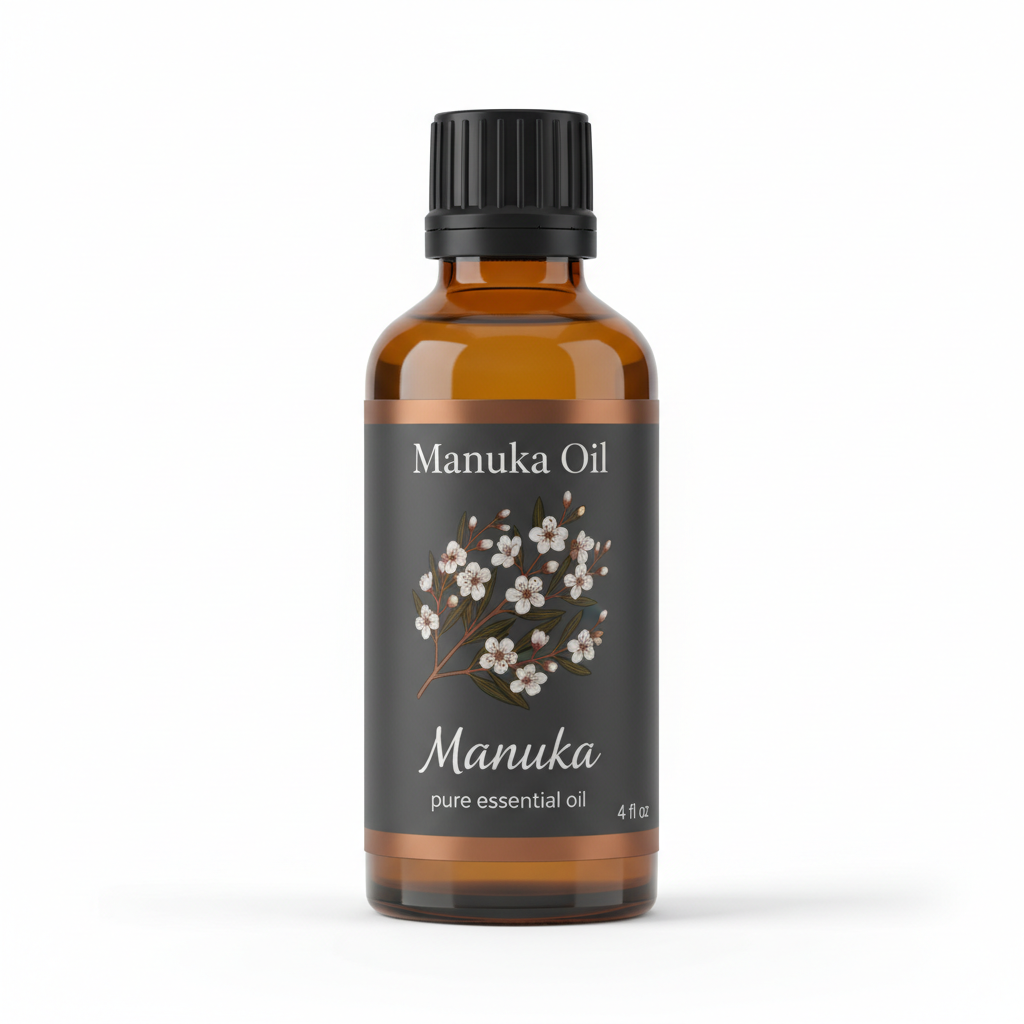
Manuka Essential Oil
Our own Manuka Essential Oil, in sizes from 0.5 oz to bulk.
From $18.99
Shop Now →A phenol against a triketone
Oregano oil is dominated by a phenol called carvacrol. In an Italian study that analysed both oils, the oregano oil was 65.93% carvacrol, 9.33% p-cymene and 5.25% gamma-terpinene, while the manuka oil was 31.65% leptospermone, 15.93% cis-calamenene and 6.92% flavesone (Fratini et al., A novel interpretation of the Fractional Inhibitory Concentration Index: The case Origanum vulgare L. and Leptospermum scoparium J. R. et G. Forst essential oils against Staphylococcus aureus strains). An assessment of a different oregano oil by a European Food Safety Authority panel found the same pattern, with 34 components and carvacrol the most prevalent at more than 60% (EFSA FEEDAP Panel, Safety and efficacy of an essential oil from Origanum vulgare subsp. hirtum (Link) letsw. var. Vulkan when used as a sensory additive in feed for all animal species).
Manuka's side is less fixed. As we cover in our East Cape article, manuka oils differ a good deal from plant to plant, so a figure from one study describes that sample and not every bottle. The Certificate of Analysis we publish for one batch lists appearance, smell, relative density 0.896, refractive index 1.489 and optical rotation, and no constituent percentages, so we do not pin the Italian numbers on our oil.
What the one head-to-head test shows
That same Italian paper is the one direct comparison we know of. The researchers tested both oils against fourteen wild strains of one common skin bacterium, Staphylococcus aureus, growing in broth, and reported a minimum inhibitory concentration (the weakest dilution that held growth back) of 1:2048 to 1:4096 by volume, without separating the two oils. In everyday terms, that is a very dilute solution: about 0.05% to 0.02%. With a dropper delivering roughly 20 drops to the millilitre, a single drop in about 100 ml of broth lands near the first figure.
The interesting message is that both oils did their work at tiny concentrations in a dish, so the dish cannot tell them apart in any way that helps a shopper. And a dish is not skin. Skin has its own oils, cells and protective layers, so the paper's closing suggestion about alternatives to drugs is the authors' extrapolation, and we do not repeat it as advice about either oil. Our antibacterial research article explains how to read an MIC.
What matters on skin
The EFSA panel's conclusion is blunt: the oregano oil should be considered an irritant to skin and eyes, with a potential for sensitisation in susceptible people. A minireview of the phenols carvacrol, thymol and eugenol likewise reports that exposure in humans may cause reactions including skin irritation, inflammation and dermatitis (Fuentes et al., Relevant essential oil components: a minireview on increasing applications and potential toxicity). Neither source is a skin trial with a stated dilution, so we have no evidence-based oregano figure to give, and we do not suggest one. If you own oregano oil, its supplier's safety data sheet is the place to start, and a pharmacist or dermatologist is the person to ask about skin.
For manuka, our guidance is a dilution of 0.5% to 2% in a carrier oil such as jojoba or sweet almond, roughly 3 to 12 drops per ounce, with a patch test first and the low end for facial blends. It is for external use only, away from eyes, children and pets. Cell-culture work found manuka and kanuka oils among the more cytotoxic of several Myrtaceae oils tested (Schnitzler et al., Comparative study on the cytotoxicity of different Myrtaceae essential oils on cultured vero and RC-37 cells), which is one more reason we prefer the cautious end of the range. Our side effects article has the practical detail.
Two very different noses
Beyond the chemistry, the simplest difference is the smell. Oregano oil is sharp, hot and savoury, the kind of scent that belongs near a pizza. Manuka is round, honeyed and warm, with a slightly spicy edge. If you open both bottles in the same room, you may well find you only want to keep one of them open for long.
That is a useful way to choose in itself. An aroma you enjoy is one you will actually use, and a strong smell is simply a strong smell. It tells you nothing about which oil is the better one for a given job.
So which one?
If a rash, a nail change or a stubborn itch is the reason you are comparing them, neither oil is the answer. A pharmacist, podiatrist or dermatologist can tell you what is going on. We sell an external cosmetic oil, nothing more, and no oregano.
If what you want is an aroma, manuka is the one we make a case for: earthy, honeyed and warm, with a slightly spicy edge, a heavier note that settles into blends. Our scent profile and pairing guide show where it fits. And oregano capsules sold to swallow are a supplement question for a pharmacist or physician. Our own oil is not for internal use, as the ingestion article explains.
One last rule for reading any lab numbers: compare them only inside a single study, with the same strain, method and units.
Manuka Essential Oil
Manuka Essential Oil from our own shop, in sizes from 0.5 oz to bulk.
From $18.99
Shop Now →Sources & Further Reading
- Fratini F et al., 2017. A novel interpretation of the Fractional Inhibitory Concentration Index: The case Origanum vulgare L. and Leptospermum scoparium J. R. et G. Forst essential oils against Staphylococcus aureus strains. Microbiological Research
- EFSA FEEDAP Panel, 2017. Safety and efficacy of an essential oil from Origanum vulgare subsp. hirtum (Link) letsw. var. Vulkan when used as a sensory additive in feed for all animal species. EFSA Journal
- Fuentes C et al., 2021. Relevant essential oil components: a minireview on increasing applications and potential toxicity. Toxicology Mechanisms and Methods
- Schnitzler P, Wiesenhofer K, Reichling J, 2008. Comparative study on the cytotoxicity of different Myrtaceae essential oils on cultured vero and RC-37 cells. Pharmazie