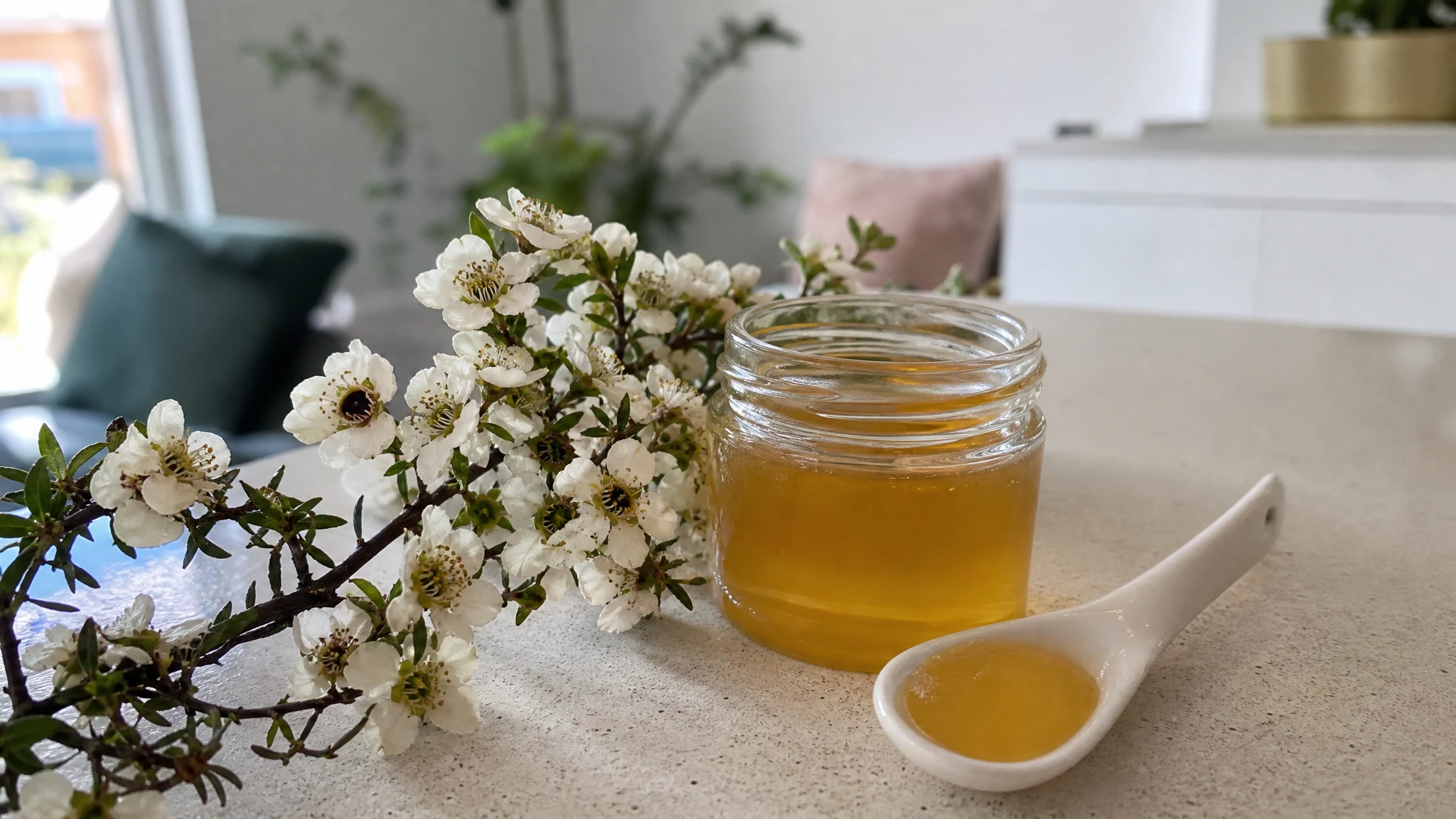
Manuka Oil vs Manuka Honey: Same Shrub, Different Products
Say "manuka" and most people think of honey. So it is no surprise that some people assume manuka oil is honey boiled down, or that everything said about the honey carries over to the oil. The truth is more interesting: both come from one shrub, Leptospermum scoparium, and after that they part ways almost completely. We sell the oil, not honey, and here is how the two differ.
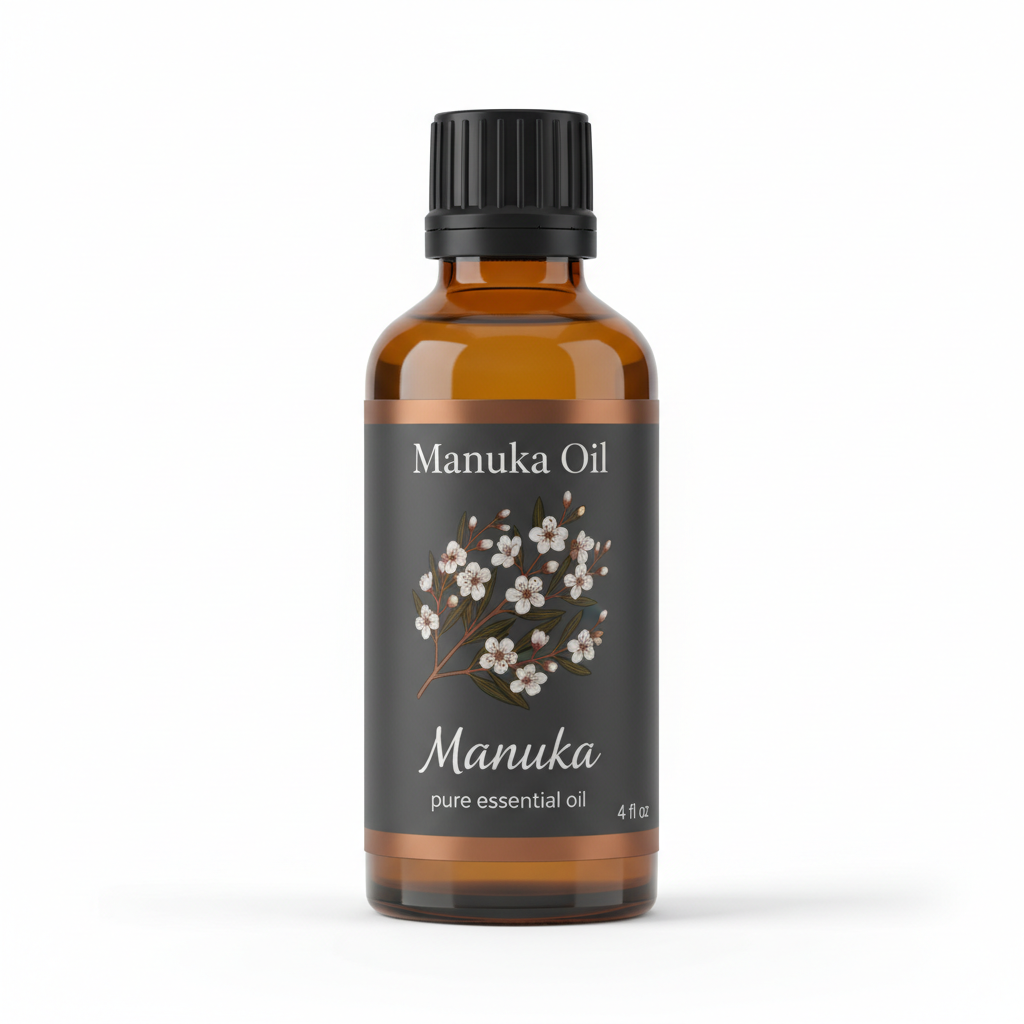
Manuka Essential Oil
Our own Manuka Essential Oil, in sizes from 0.5 oz to bulk.
From $18.99
Shop Now →One shrub, two routes
Honey is made by bees. A Cochrane review describes it as "a viscous, supersaturated sugar solution derived from nectar gathered and modified by the honeybee." Manuka oil is steam distilled from the leaves and young stems, with a reported yield of roughly 0.2 to 1% of the plant material's weight. There is no step that turns one into the other, so there is no oil made from honey. A sugar syrup and a volatile plant distillate simply do not meet in a process. If you ever see something labelled "honey oil", read the ingredient list.
The compound that made honey famous is not a leaf compound
Manuka honey's reputation rests on methylglyoxal. In 2008, researchers measured six New Zealand manuka honeys and found it at 38 to 761 mg/kg, up to 100 times the level in conventional honeys. In dish experiments, the honeys held back the growth of two common bacteria when diluted to 15 to 30%, which matched methylglyoxal levels of 1.1 to 1.8 mM. These were laboratory tests, not studies of people.
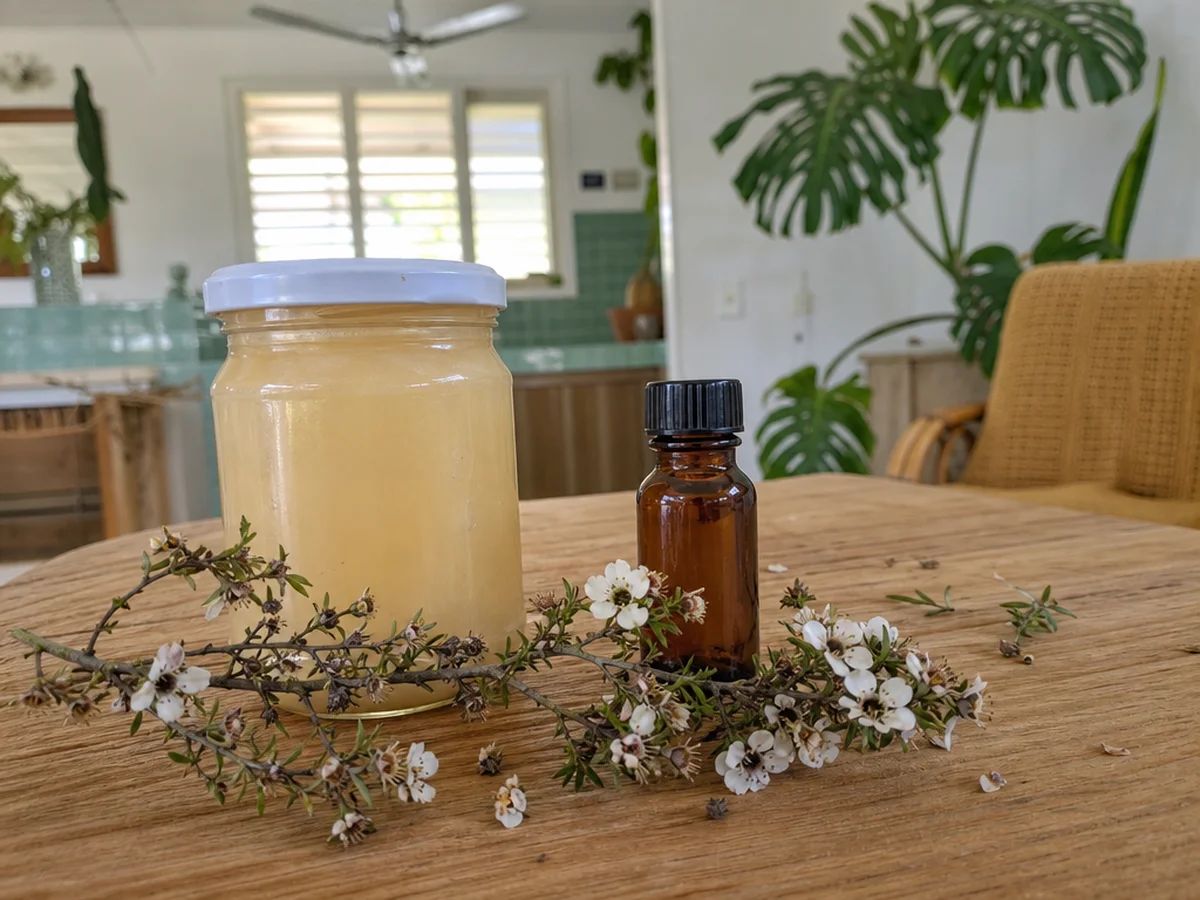
Here is the neat twist. A 2009 study traced methylglyoxal to dihydroxyacetone in the flower nectar. Freshly made honey was low in methylglyoxal and high in dihydroxyacetone, warm storage shifted the balance, and nectar collected from the flowers contained dihydroxyacetone and no detectable methylglyoxal. In other words, the compound is a product of what happens in the hive and the jar. A leaf distillate is not where you would look for it. The oil has its own signature chemistry, with a large sesquiterpene fraction and, in commercial oils, triketones such as leptospermone reported at 0.8% to 19.4% in a 2020 review. Our article on origin and region explains why those figures vary so much.
| Manuka honey | Manuka oil | |
|---|---|---|
| Made from | Flower nectar, by bees | Leaves and young stems, by steam distillation |
| What it is | A sugar solution | A volatile oil with no water |
| Marker in the literature | Methylglyoxal, from nectar dihydroxyacetone | Sesquiterpenes and triketones, varying by chemotype |
Honey's wound evidence belongs to honey
The Cochrane review of honey as a wound treatment covered 26 trials and 3,011 participants. It found high quality evidence that honey dressings healed partial thickness burns about 4.7 days faster than usual dressings (two trials, 992 people), while for most other comparisons the evidence was low or very low quality. All of that concerns honey dressings. It says nothing about distilled oil, and a cut or burn that needs dressing belongs with a nurse, pharmacist or doctor. The oil's own evidence is mostly laboratory work, and the 2020 oil review left honey out of its search entirely, so it is a review of the oil on its own. Our research map sets out what exists.
That is why we are careful with borrowed reputations. If a listing for an oil quotes a honey grade, a methylglyoxal figure or a honey study as proof of what the oil does, ask which material was measured.
Does "honeyed" mean honey?
No, it is a scent word. We describe the aroma of our oil as earthy, honeyed and warm with a slightly spicy edge, and the Certificate of Analysis we publish for one batch records "Sweet, Honey, Herbal". We sell the oil neat, with no additives or fillers, so nothing in the bottle but the distilled oil. Whether you find it honey-like is up to your nose.
Please do not blend them to eat
Our oil is not for internal use, so it does not go into honey, food or drinks. Our piece on swallowing covers what poison control sources advise. For skin, our dilution guidance is 0.5% to 2% in a carrier oil with a patch test first, and a water-based sugar syrup would make a poor carrier for an oil that does not dissolve in water anyway, which is reasoning from the Cochrane description of honey.
Two shelves, two habits
It helps to think of them as living in different parts of the house. Honey belongs in the kitchen, in a jar with a spoon, and it is a food. The oil belongs with your craft and aroma supplies, in a small tightly capped bottle you count drops from. They do not share tools, and they do not share a cupboard.
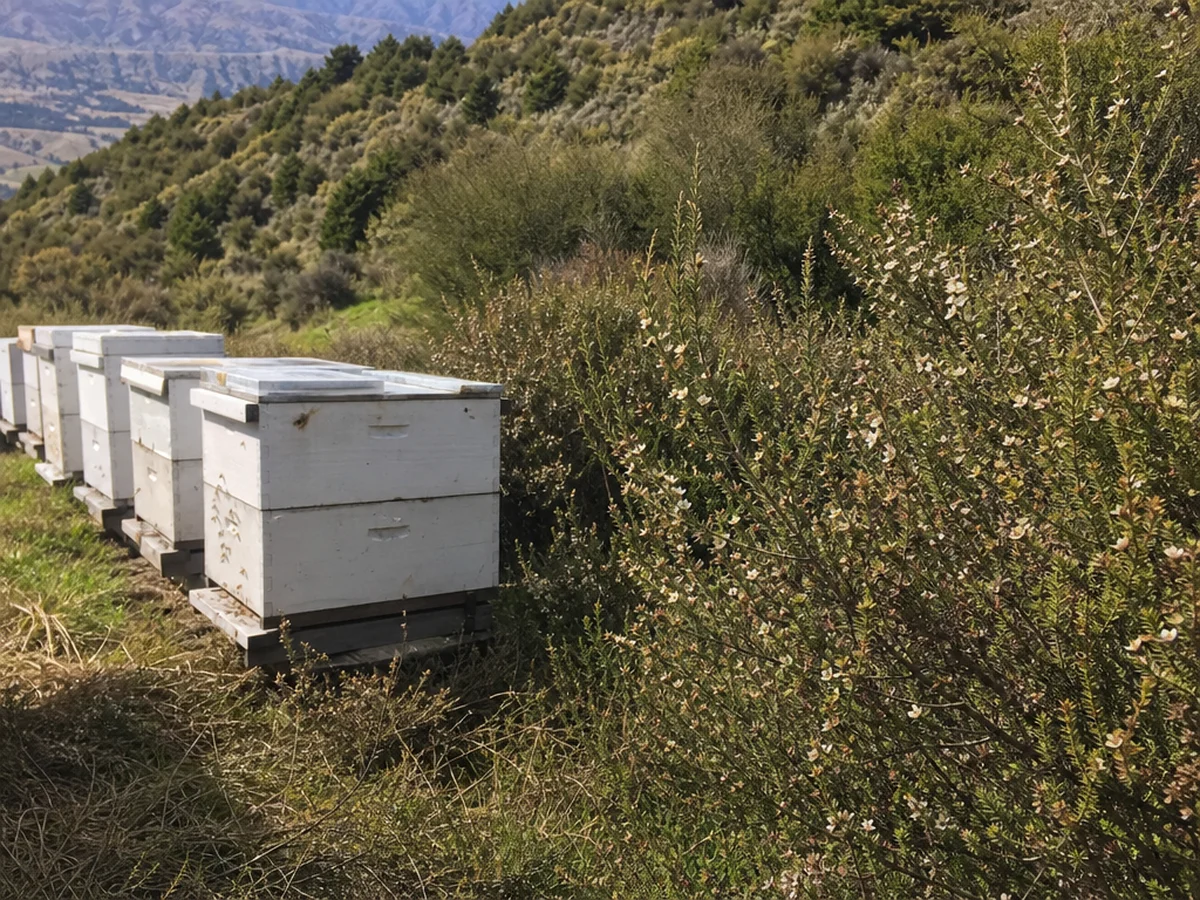
A drop of the oil on a paper strip beside a spoonful of honey makes the point at once: one smells of leaves and warm spice, the other of sugar. "Honeyed" is a fair word for the oil, but your nose will tell you they are different things. If you love the idea of the shrub itself, there is nothing wrong with owning both. Just let each do its own job.
Which to choose
If you want something to eat, or a dressing for a wound under a clinician's guidance, you want honey bought from the honey trade. If you want a deep, leafy oil for scenting blends, diluted skin products, soap or candles, you want the oil, and our guide to what manuka oil is is a good place to start. Each tells you very little about the other, and enjoying one does not require the other.
One shrub, two quite different gifts: a sweet food from the flowers and a heavy, aromatic oil from the leaves.
Manuka Essential Oil
Manuka Essential Oil from our own shop, in sizes from 0.5 oz to bulk.
From $18.99
Shop Now →Sources & Further Reading
- Jull AB, et al., 2015. Honey as a topical treatment for wounds. Cochrane Database Syst Rev. PMID 25742878
- Mavric E, et al., 2008. Identification and quantification of methylglyoxal as the dominant antibacterial constituent of Manuka (Leptospermum scoparium) honeys from New Zealand. Mol Nutr Food Res. PMID 18210383
- Adams CJ, Manley-Harris M, Molan PC, 2009. The origin of methylglyoxal in New Zealand manuka (Leptospermum scoparium) honey. Carbohydr Res. PMID 19368902
- Mathew C, et al., 2020. Mānuka Oil-A Review of Antimicrobial and Other Medicinal Properties. Pharmaceuticals. PMC7694078