
What Is Manuka Oil? Plant, Scent and Safe Use
Say "manuka" to most people and they think of honey. Say it to a tea tree fan and they expect something sharp and medicinal. The oil is neither, and the best way to understand it is to start with what it is often mistaken for.
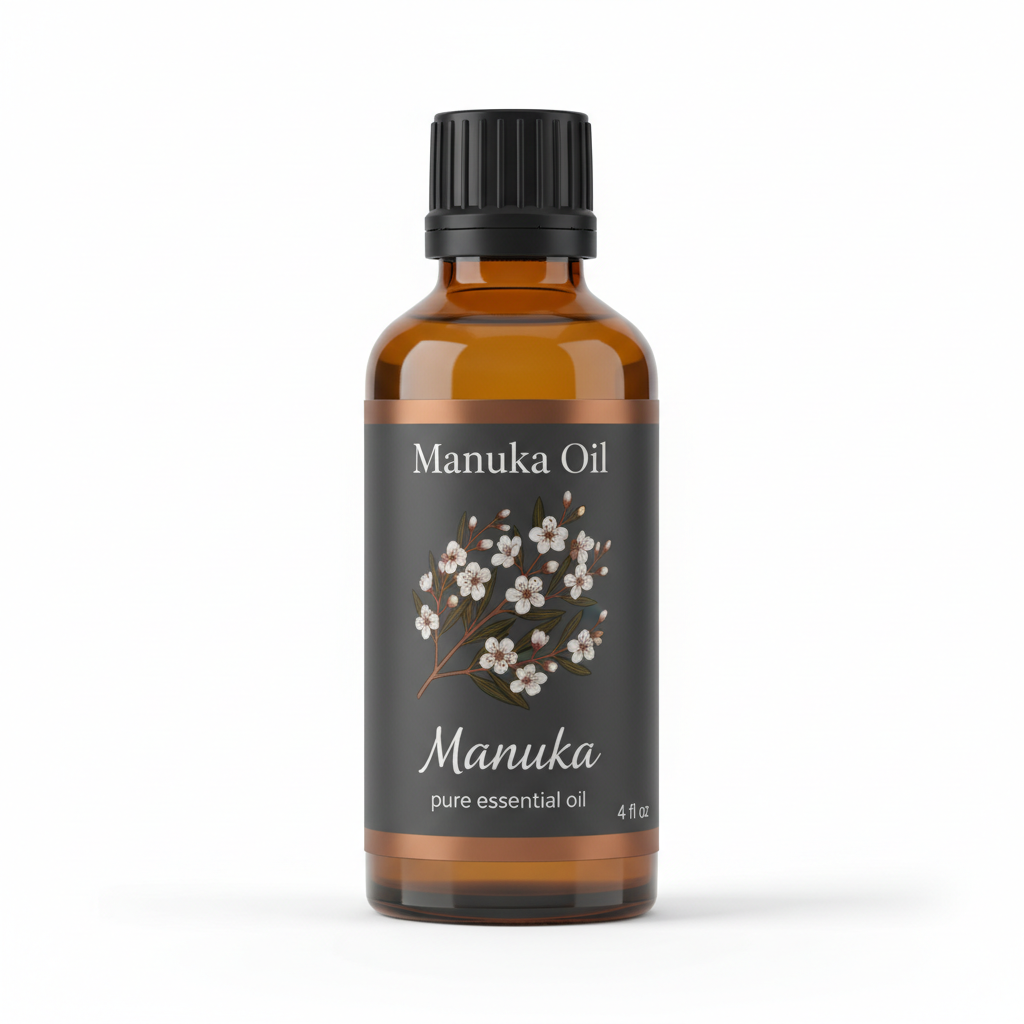
Manuka Essential Oil
Our own Manuka Essential Oil, in sizes from 0.5 oz to bulk.
From $18.99
Shop Now →Not honey, not tea tree, not kanuka
Not honey. Same shrub, very different material. Bees make the honey from nectar, while the oil is steam-distilled from foliage. The compound that gets so much attention in manuka honey, methylglyoxal, forms from dihydroxyacetone in the flower nectar, so reasoning from that origin, a leaf distillate is a different product altogether. Our honey versus oil comparison goes deeper.
Not tea tree. In everyday speech "tea tree" can mean manuka or the Australian species behind tea tree oil, which has a different oil. A 2020 review reports terpinen-4-ol, the signature compound of tea tree oil, at only 0.8 to 1.4% in manuka. Our tea tree comparison sets the two side by side.
Not kanuka. The neighbouring plant has a similar name and gives an oil dominated by different compounds. See manuka versus kanuka.
The plant behind the bottle
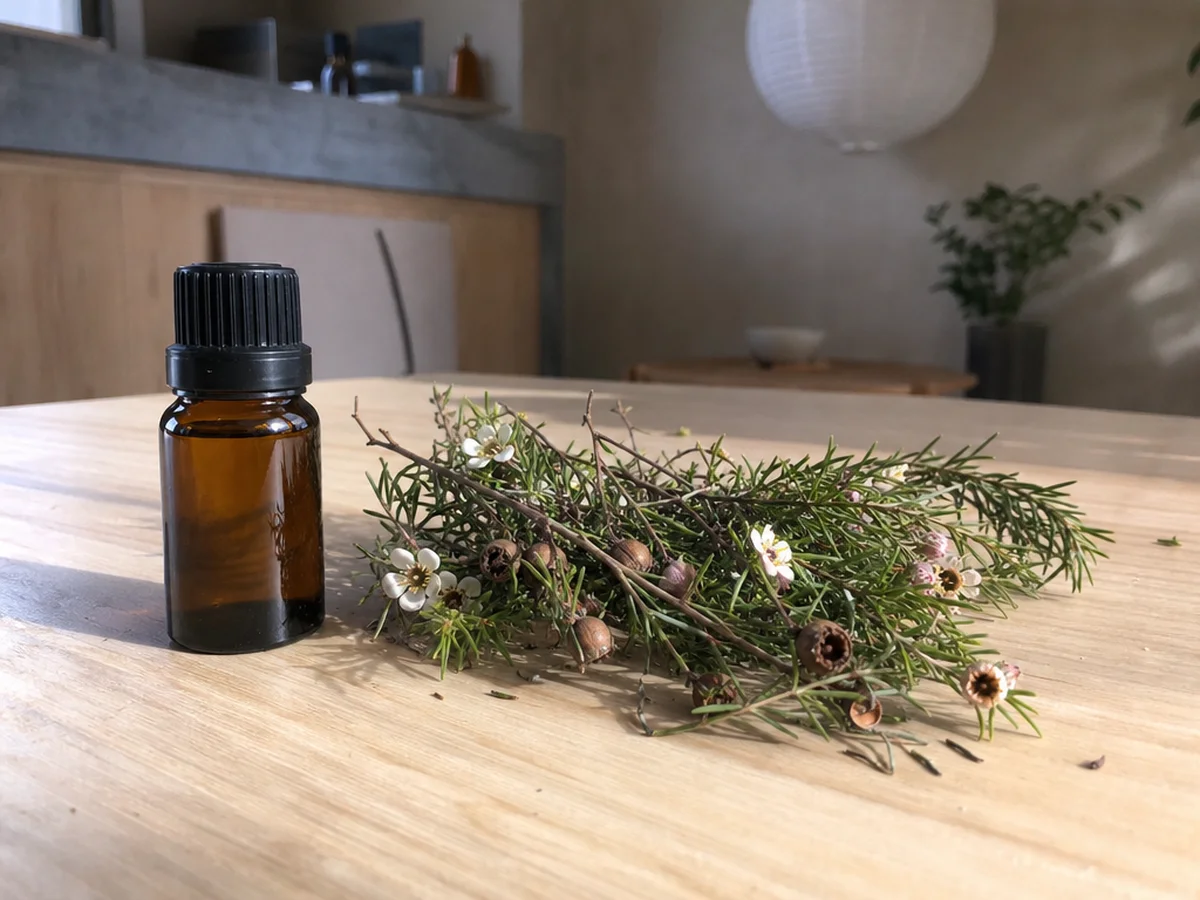
The oil comes from Leptospermum scoparium, a shrub in the myrtle family that grows across New Zealand and Australia and goes by names such as kahikatoa and red manuka. Its leaves and young stems are the usual raw material for the oil, and steam distillation yields only about 0.2 to 1% oil depending on season and place. In kitchen terms, 100 kg of plant gives somewhere between 200 g and 1 kg of oil, which is why a single drop is so concentrated. It is also why we tell people a drop or two goes a long way.
Traditional uses of the plant itself, such as bark and leaf infusions, are well documented in the review's sources, but they involve plant parts rather than a distilled oil, so we do not treat them as telling you anything about ours.
Why two bottles can smell and behave differently
This is the most interesting thing about manuka oil. A survey of 261 plants at 87 New Zealand sites found that the oil's chemistry varies enormously: one chemotype, found on the East Cape, was rich in compounds called triketones, and the researchers described ten further chemotypes, including an alpha-pinene type and a geranyl acetate type with a notable aroma. Commercial oils in the 2020 review ranged from 0.8% to 19.4% leptospermone, the best-known triketone. The takeaway is simple: "manuka oil" is a family of oils, and a label alone does not tell you which member you have. The origin article picks that thread up.
What we sell, and how it smells
We sell one oil: Manuka Essential Oil, Leptospermum scoparium, steam-distilled, sold neat with no additives or fillers, in amber glass at sizes from 0.5 oz up to bulk. We describe the aroma as earthy, honeyed and warm with a slightly spicy edge, deeper and sweeter than tea tree, and it settles into a blend like a wood oil. It pairs well with lavender, bergamot, sweet orange, geranium and cedarwood, which makes it a lovely heavier note for diffuser blends, soap and candle work, and diluted skincare oils.
The Certificate of Analysis we publish for one batch lists a clear liquid, a smell of "Sweet, Honey, Herbal", a relative density of 0.896, a refractive index of 1.489 and an optical rotation of -3.84 degrees, all at 20 C. It does not carry a GC-MS or triketone figure, so if your project needs one, ask us in writing through our contact page before you order. Our certificate walkthrough explains each line.
Getting to know the scent
The best introduction to manuka oil is simply to smell it. Hold the bottle a little way from your nose rather than right under it, and take a slow breath. You will probably catch the sweetness first, then something leafy and earthy, and a little warm spice at the edge. It does not shout the way some oils do; it settles.
Try it a few ways: on a paper strip, in a diffuser with a drop or two, and, once you have diluted it properly, in a small skin blend. The same oil can feel quite different in each setting, and finding the one you like is half the fun. Partners such as lavender, sweet orange and cedarwood show off different sides of it.
Who it suits
Manuka is a good fit if you like deep, warm scents, if you enjoy making soap, candles and sprays, or if you want a heavier note to anchor a lighter blend. It is less of a fit if you are after a sharp, bright smell, and that is perfectly fine: choose the oil that matches your nose.

Using it sensibly
Because the oil is concentrated, we recommend diluting to 0.5% to 2% in a carrier oil, which is roughly 3 to 12 drops per ounce, starting at the low end and patch testing first. That is our guidance rather than a safety clearance: Tisserand states that undiluted essential oils should not be applied to the skin, and you should check IFRA standards for any product you plan to sell. Keep the oil away from eyes, children and pets, and do not swallow it. This is an external cosmetic oil, and anything health-related is a question for a pharmacist or physician.
That is manuka oil in a nutshell: a rich, honeyed leaf oil from a remarkably variable plant, best chosen with a clear idea of what you want to do with it.
Manuka Essential Oil
Manuka Essential Oil from our own shop, in sizes from 0.5 oz to bulk.
From $18.99
Shop Now →Sources & Further Reading
- Mathew C et al., 2020. Mānuka Oil-A Review of Antimicrobial and Other Medicinal Properties. PMC7694078
- Douglas MH et al., 2004. Essential oils from New Zealand manuka: triketone and other chemotypes of Leptospermum scoparium. pubmed.ncbi.nlm.nih.gov/15184010
- Adams CJ, Manley-Harris M, Molan PC, 2009. The origin of methylglyoxal in New Zealand manuka (Leptospermum scoparium) honey. pubmed.ncbi.nlm.nih.gov/19368902
- Tisserand Institute. How to Use Essential Oils Safely. tisserandinstitute.org/safety/safety-guidelines