How to Dilute Manuka Oil: Drops, Ratios, Patch Tests
Manuka oil arrives in the bottle as a concentrate, and a drop or two goes a long way. The skill that matters most when you bring it into a skin or hair routine is not a secret technique, it is simple counting: how many drops belong in how much carrier, and how long to wait before you trust your own patch test.
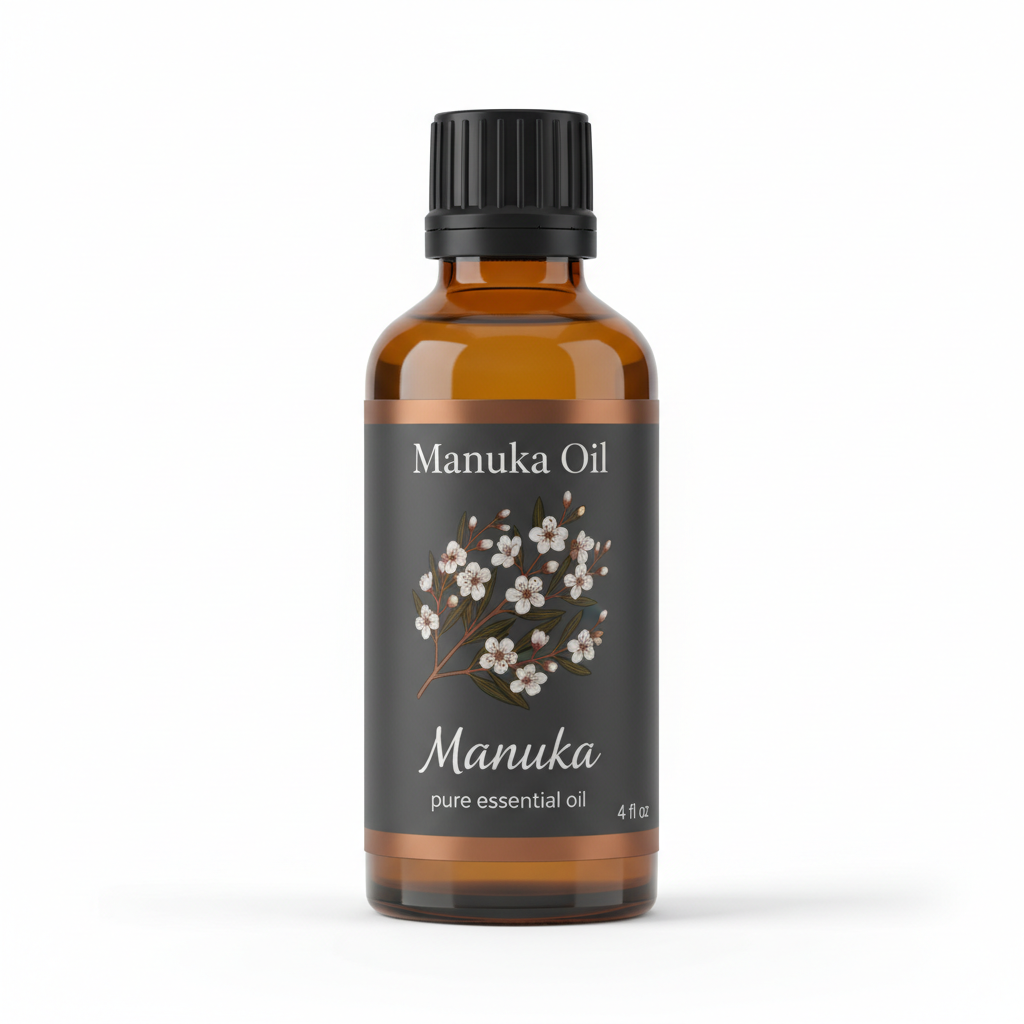
Manuka Essential Oil
Our own Manuka Essential Oil, in sizes from 0.5 oz to bulk.
From $18.99
Shop Now →Start with the percentage, then count drops
Our dilution guidance is 0.5% to 2% in a carrier oil, which works out to roughly 3 to 12 drops per ounce, and we suggest you begin at the low end, especially for anything near the face. Safety specialists agree on the principle even where they do not give a number for manuka. The Tisserand Institute puts it plainly: "Do not apply undiluted essential oils to your skin," and notes that "dilution and risk are directly linked." We are not aware of a manuka-specific ceiling from them or from DermNet, so treat 2% as the top of a range to approach carefully rather than a target, and check IFRA standards if you are formulating something beyond a simple personal blend.
Here is the arithmetic, assuming the usual convention of about 20 drops to a millilitre. Droppers differ, so a small kitchen scale is more accurate than counting.
| Carrier volume | 0.5% | 1% | 2% |
|---|---|---|---|
| 10 ml roller bottle | 1 drop | 2 drops | 4 drops |
| 30 ml (1 oz) | 3 drops | 6 drops | 12 drops |
| 100 ml | 10 drops | 20 drops | 40 drops |
The batch on our Certificate of Analysis has a relative density of 0.896, so a millilitre of oil weighs about 0.9 g. Write the percentage and the date on every bottle you mix. A blend with no label is the easiest way to lose track of what you made. If you are choosing a carrier, our carrier oil guide covers what keeps well and what to watch for, and the piece on undiluted use shows how big the gap is between a drop from the bottle and a drop in an ounce of carrier.
A patch test that waits long enough
This is the step people rush. DermNet describes allergic contact dermatitis to essential oils as a delayed reaction that generally shows up 24 to 72 hours after exposure, usually as itching, redness and scaling. Clinics apply test patches to the back, remove them at 48 hours and read them again 48 to 96 hours later. At home, a dab of your finished blend on the inner forearm that looks fine after ten minutes has told you very little. Waiting three days before you use it on a larger area lines up with the window DermNet describes. That is our reasoning for a home version, and it is a rough stand-in for clinic testing, not an equal.
It is worth doing even for a "natural" oil. In a patch-test clinic in Australia, 41 of 2,320 people tested reacted to oxidized tea tree oil, about 1.8%, and eight of those 41 had used it undiluted. Those were patients referred to a clinic and the oil was a different one, so it is not a general rate. It simply shows that plant oils can sensitise some people.
Matching the blend to the spot
Where the oil goes and how long it stays decides how cautious to be. No source we read gives separate manuka limits, so this is practical reasoning.
- Face and neck: start at 0.5% and keep it away from the eyes.
- Body: a bigger area means a bigger total amount at the same percentage, so patch test first and stay inside our range.
- Scalp, leave-on: it stays put for hours, so treat it like a face blend. Our scalp routine post goes into more detail.
- Rinse-off products: contact is shorter. The shampoo post works through drops per bottle.
A practical habit that helps: mix in the same small bottle every time, with the same dropper, and do your counting somewhere quiet. Drop counting is dull, and the easiest mistakes happen when you are chatting or rushing. If you lose count, tip the bottle out and begin again; a spoiled ounce of carrier is a small price.
Know when to stop
Stop using a blend if you notice itching, redness, scaling, burning or blisters, and see a dermatologist if it does not settle or spreads. DermNet notes that avoiding the oil usually resolves a reaction, while continued low-level exposure can lead to chronic dermatitis, so "it only stings a little" is not a reason to carry on. Irritation from too much oil, true allergy and a reaction to the carrier can look alike, which is why our sensitive skin guide and side effects guide walk through telling them apart. Keep broken skin clear of any oil blend, and do not hand leftovers to someone else.
Keep the oil fresh
Old, oxidized oil is a poorer bet than a fresh bottle. In a classic tea tree study, fresh oil was a very weak sensitiser in guinea pigs while oxidized oil was about three times stronger, with peroxides climbing from under 50 to over 500 ppm in four days on a window sill. That was a different oil, so the takeaway for manuka is an inference: keep the cap tight, store it somewhere cool and dark as we advise, and mix small batches you will use up. Our shelf life guidance is typically 2 to 3 years when the bottle is kept tightly capped, cool and dark.
A few groups should talk to a professional first. If you are pregnant, ask an OB/GYN or midwife. If you have eczema, a fragrance allergy or a history of reacting to essential oils, a dermatologist is the right first call. Our oil is an external cosmetic oil, to keep away from eyes, children and pets, and never for internal use.
So the routine worth building is a short procedure: pick a percentage, count the drops, label the bottle, wait three days, and let your skin tell you whether to continue.
Manuka Essential Oil
Manuka Essential Oil from our own shop, in sizes from 0.5 oz to bulk.
From $18.99
Shop Now →Sources & Further Reading
- Tisserand Institute, Safety Guidelines - Tisserand Institute. tisserandinstitute.org/safety/safety-guidelines
- DermNet, Allergic contact dermatitis to essential oils. dermnetnz.org/topics/allergic-contact-dermatitis-to-essential-oils
- Rutherford T, Nixon R, Tam M, Tate B, 2007. Allergy to tea tree oil: retrospective review of 41 cases with positive patch tests over 4.5 years. Australas J Dermatol. PMID 17535193
- Hausen BM, Reichling J, Harkenthal M, 1999. Degradation products of monoterpenes are the sensitizing agents in tea tree oil. Am J Contact Dermat. PMID 10357714