Why Is Manuka Oil Expensive? What Drives the Cost
Two bottles of manuka oil can be the same size and sit at very different prices, and the label rarely explains why. We do not quote prices in our articles (our shop and bulk pages carry the current ones), but we can tell you what the research says shapes the cost of this oil, and how to compare quotes fairly.
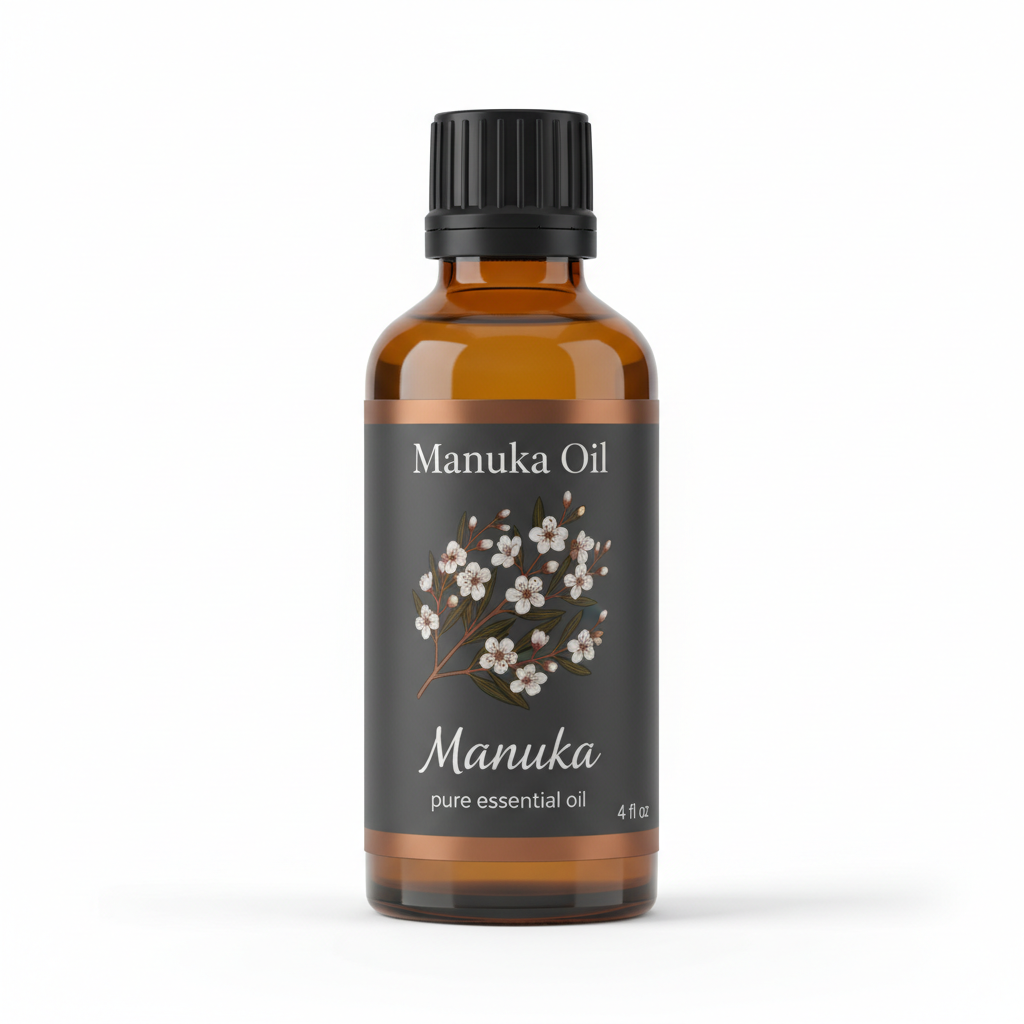
Manuka Essential Oil
Our own Manuka Essential Oil, in sizes from 0.5 oz to bulk.
From $18.99
Shop Now →It takes a lot of plant
A 2020 review reports that steam distillation of manuka gives about 0.2 to 1% oil depending on season and geography, mostly from leaves and young stems. The review does not say whether that is by fresh or dry weight, so treat our sums as indicative. If it is by weight of plant, a kilogram of oil takes between 100 kg and 500 kg of leaf and stem, and a 0.5 oz bottle, holding about 13 g at the density on our published certificate, stands for roughly 1.3 to 6.6 kg of plant. That is a statement about the plant in general rather than a yield for our own lots, but it explains why harvest, transport and distillation weigh heavily against the little oil that comes out.
It is a family of oils, not one product
The bigger story is chemistry. A survey of 261 plants at 87 New Zealand sites found a triketone-rich chemotype concentrated on the East Cape and ten others, including alpha-pinene, geranyl acetate and linalool types. Commercial oils in the 2020 review ranged from 0.8% to 19.4% leptospermone. If a triketone-rich oil is rarer than a sesquiterpene-rich one, then a price gap may reflect a real compositional gap, which is our reasoning rather than a finding. It might also reflect a label that says "triketone" with no number behind it. Only a quantitative report for the lot tells you which.

Our certificate lists physical measurements for one batch and no triketone figure, so we do not claim a chemotype for our oil. If your project depends on one, ask us in writing through the contact page before ordering. Our label article goes through the phrases to look out for, and the origin article covers what a region name can and cannot tell you.
Paperwork has a cost too
A document with a lot number, a method and a named laboratory takes effort to produce, so it is reasonable to put it on your comparison sheet as a line item. A 2021 study of adulteration found that dilution with a heavy vegetable oil is invisible in normalised GC percentages and shows up only in an absolute quantitative analysis. A much lower quote with no quantitative document may therefore be a smaller price for a different thing. That does not prove anything is wrong, only that it is worth asking the questions in our quality checks article.
Comparing quotes properly
- Convert to grams. A fluid ounce of the batch on our certificate (relative density 0.896) weighs about 26.5 g, while a weight ounce is 28.35 g, about 7% more. Confirm which a seller means, and use 453.6 g per pound for pound sizes.
- Divide price by grams. Do the division yourself from the seller's number.
- Think in drops or batches. At about 20 drops per ml, a 0.5 oz bottle is around 296 drops. Our guidance of 3 to 12 drops per ounce of carrier means a one-ounce 2% batch uses about 12, so that bottle covers roughly 25 batches.
- Note the paperwork. Is there a lot-specific document, what does it measure, and is a laboratory named?
- Allow for shelf life. We say the oil typically keeps 2 to 3 years when capped tightly, cool and dark, so a bigger bottle you cannot finish in that time gives back what it saved. Our bottle size article works the numbers for each retail size.
Why we skip the tea tree comparison
People often ask why manuka costs more than tea tree. We have not found a source comparing the two oils' market prices, so we do not claim one. What the literature shows is that they are different oils: New Zealand manuka is low in monoterpenes and carries little terpinen-4-ol, the compound that defines tea tree oil. Comparing the cost of two different oils compares products, not grades of one. Our tea tree comparison sets out the chemistry and the aroma.
The honest way to shop
Our suggestion: pick the use first, then the budget, then the questions. Someone who wants a small bottle for a diffuser has very different needs from someone formulating a product, and neither needs to pay for what the other requires. When a bottle seems expensive, divide it by the number of batches or diffuser sessions it will cover, and the picture often changes.
And do smell it. A small bottle you love is better value than a large one you never reach for.
When more is not worth it
If you want manuka for scent in a candle or soap, a triketone percentage matters little, and paying for a documented high-triketone oil buys something you will not use. If you are formulating a product that names a chemotype, you need the number, in writing, for the lot you will get. For volume, our wholesale page offers sample bottles, which is the cheapest way to test a supplier before committing. Our bulk page lists 5, 25 and 400 lb sizes; at the batch density those are roughly 2.5, 12.7 and 202 litres, so a quote per pound and a quote per litre of the same oil differ by that density factor. Convert before you compare.
Work out the grams and the drops, ask for the lot document, and compare the answers. A price that holds up to that is fair for what you are getting.
Manuka Essential Oil
Manuka Essential Oil from our own shop, in sizes from 0.5 oz to bulk.
From $18.99
Shop Now →Sources & Further Reading
- Mathew C et al., 2020. Mānuka Oil-A Review of Antimicrobial and Other Medicinal Properties. PMC7694078
- Douglas MH et al., 2004. Essential oils from New Zealand manuka: triketone and other chemotypes of Leptospermum scoparium. pubmed.ncbi.nlm.nih.gov/15184010
- Capetti F et al., 2021. Adulteration of Essential Oils: A Multitask Issue for Quality Control. Three Case Studies: Lavandula angustifolia Mill., Citrus limon (L.) Osbeck and Melaleuca alternifolia (Maiden & Betche) Cheel. PMC8471154