Manuka Oil FAQ: Answers to the Questions We Expect
Say "manuka" to ten people and you get ten different pictures: honey in a jar, a tea tree cousin, a hillside shrub in New Zealand. The oil we sell is its own thing, and most of the questions we expect about it come down to a handful of ideas. Here they are, one at a time.
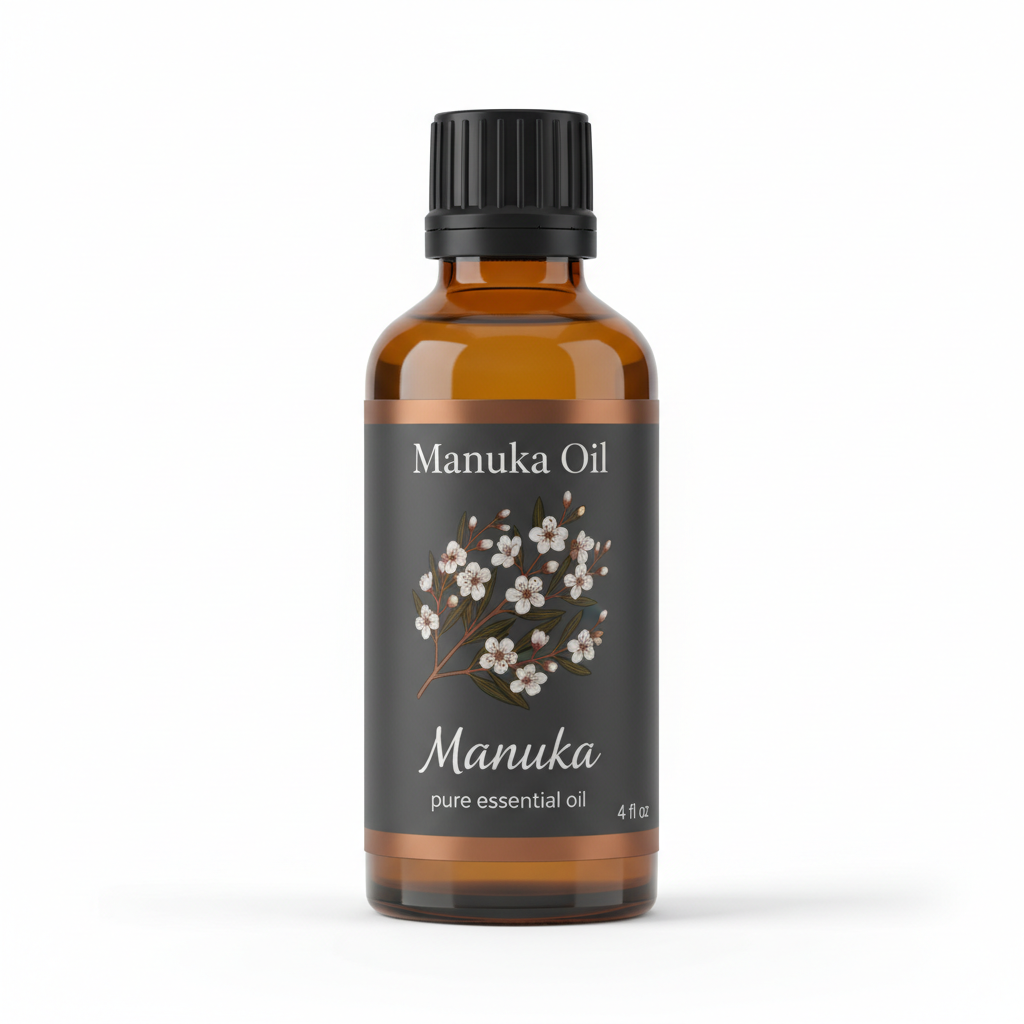
Manuka Essential Oil
Our own Manuka Essential Oil, in sizes from 0.5 oz to bulk.
From $18.99
Shop Now →What exactly is manuka oil?
It is the essential oil of Leptospermum scoparium, a shrub of the myrtle family that grows in New Zealand and Australia. Our oil is steam-distilled from leafy branches, sold neat with no additives or fillers. A 2020 review puts typical yields at 0.2 to 1% of the plant material, which is a lot of branch for a small bottle (Mathew et al.). The full story of how it is made is in our distillation article.
What does it smell like?
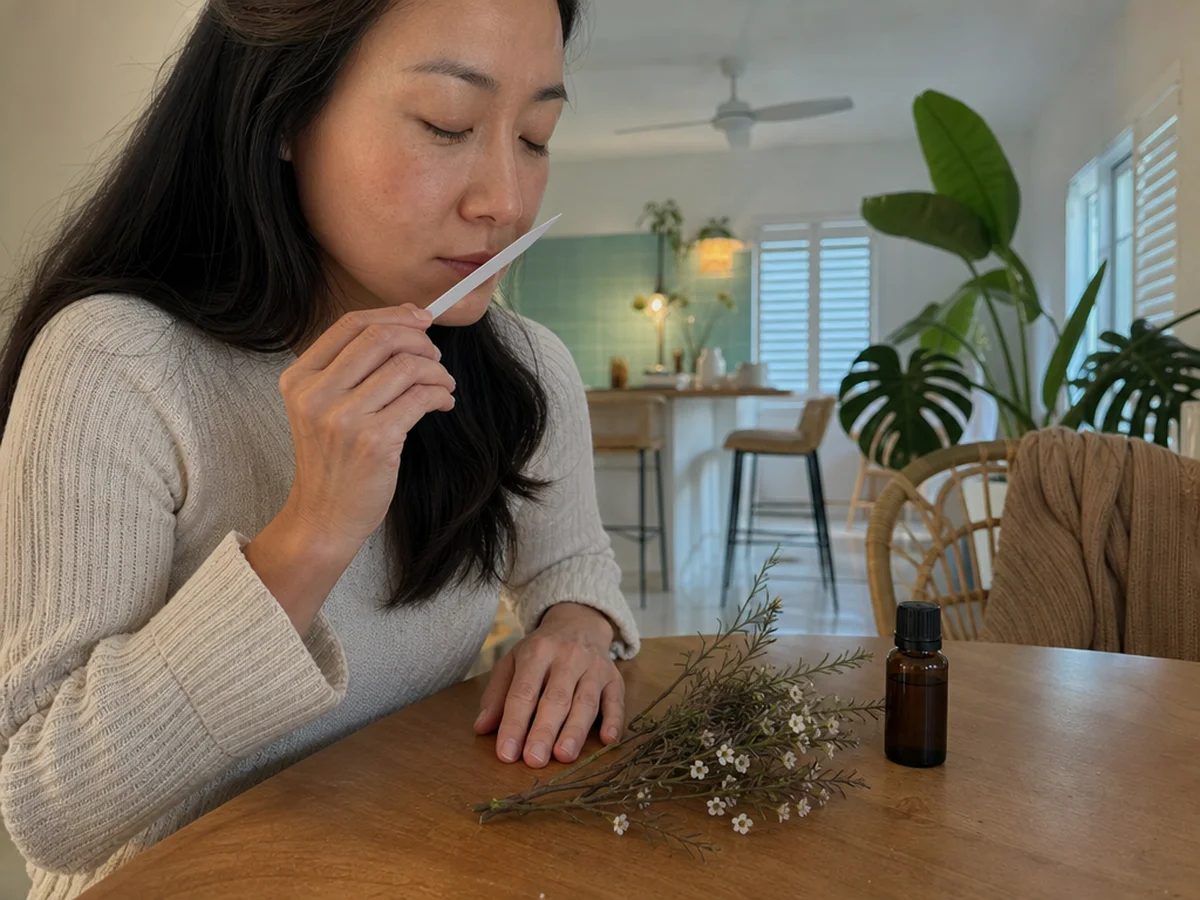
Open the bottle and take a short sniff from a little distance. We describe the aroma as earthy, honeyed and warm, with a slightly spicy edge, deeper and sweeter than tea tree. It is a low, settled scent rather than a bright one, and a drop or two goes a long way, so there is no need to go hunting for more. Our scent article takes it slowly.
Is it the same as manuka honey?
No. They share a plant and a name, and that is about it. The honey is a food whose best-known marker is methylglyoxal, found at 38 to 761 mg/kg in six New Zealand honeys in one study (Mavric et al.). That number belongs to honey, and nothing about it carries over to the oil. Our honey versus oil comparison goes deeper.
Is it the same as tea tree oil?
It is a different plant with different chemistry. The Mathew review reports terpinen-4-ol, tea tree's signature compound, at only 0.8 to 1.4% in manuka oil, while a survey of 16 commercial manuka oils found sesquiterpene hydrocarbons making up 60 to 70% of the oil (Christoph et al.). In practice that means a recipe written for one oil should not simply be swapped to the other.
Does where it grows matter?
For the plant, yes. A survey of 261 plants across 87 New Zealand sites found that every East Cape plant sampled was rich in triketones, while other regions showed ten further chemical types (Douglas et al.). That is a finding about plants in the wild. If region matters for your project, ask us in writing through our contact page before you order.
How do I dilute it for skin?
Our guidance is 0.5% to 2% in a carrier oil such as jojoba or sweet almond, with a patch test first. We suggest starting at 0.5% and going up only if your skin is happy, especially on the face. In a 1 oz (30 ml) bottle of carrier that works out to about 3 drops at 0.5% and about 12 at 2%, counting 20 drops to the millilitre. The Tisserand Institute is clear that undiluted essential oils do not belong on the skin, and DermNet NZ notes that reactions to essential oils are delayed, so wait a few days after a test spot before widening use. We cover this properly in our piece on using the oil undiluted.
What can I do with it?
The uses we have in mind are simple ones: an earthy diffuser blend, a diluted skincare oil, a scalp or beard blend, soap and candle making, or a linen spray. Because our oil is sold neat, whatever you make starts with a little arithmetic, and a small test batch is a kind way to find out whether you like the result before you commit to a big one.
Can it be swallowed?
No. It is an external oil, and we do not recommend swallowing any amount. If someone has swallowed it, call poison control or a doctor right away. The swallowing article has the steps.
What about pregnancy, children and pets?
Keep the bottle away from children and pets, and check with your midwife or obstetrician about pregnancy. We sell a cosmetic oil and do not make health claims, so those conversations belong with the professionals. Our pregnancy article sets out what the authorities say.
Where should I keep it?
Somewhere you will not trip over it: a cupboard or drawer away from the radiator and the sunny windowsill, with the cap pushed on firmly after every use. Up high is better still, out of reach of children and pets. If you like to label things, a small sticker with the date you opened the bottle takes five seconds and saves you guessing later.
How long does a bottle last?
Our guidance is typically 2 to 3 years when it is tightly capped and kept cool and dark. Air, heat and light are what age an oil, and the NCCIH notes that tea tree products that are old or exposed to heat, light or air are more likely to irritate (NCCIH). Our storage guide has the habits that matter.
What does the Certificate of Analysis tell me?
The certificate for one batch lists the botanical name, a best-by date of 11/30/2027, a clear liquid with a "Sweet, Honey, Herbal" smell, a relative density of 0.896, a refractive index of 1.489 and an optical rotation of -3.84 degrees at 20 C. If you need GC-MS or other figures for your own work, ask us in writing through the contact page before ordering. Our line-by-line walkthrough explains each entry.
Small habits that help
Wipe the neck of the bottle after pouring, recap it straight away, and use a clean dropper or a small glass dish when you measure. None of it is fussy, and all of it keeps the oil pleasant to use for as long as you have it.
Not on the list? Send us the question; we would rather answer it than guess.
Manuka Essential Oil
Manuka Essential Oil from our own shop, in sizes from 0.5 oz to bulk.
From $18.99
Shop Now →Sources & Further Reading
- Mānuka Oil-A Review of Antimicrobial and Other Medicinal Properties, Pharmaceuticals (Basel), 2020
- Identification and quantification of methylglyoxal as the dominant antibacterial constituent of Manuka (Leptospermum scoparium) honeys from New Zealand, Mol Nutr Food Res, 2008
- The composition of commercial manuka oils from New Zealand, Journal of Essential Oil Research, 1999
- Essential oils from New Zealand manuka: triketone and other chemotypes of Leptospermum scoparium, Phytochemistry, 2004
- How to Use Essential Oils Safely, Tisserand Institute
- Allergic contact dermatitis to essential oils, DermNet NZ
- Tea Tree Oil: Usefulness and Safety, NCCIH